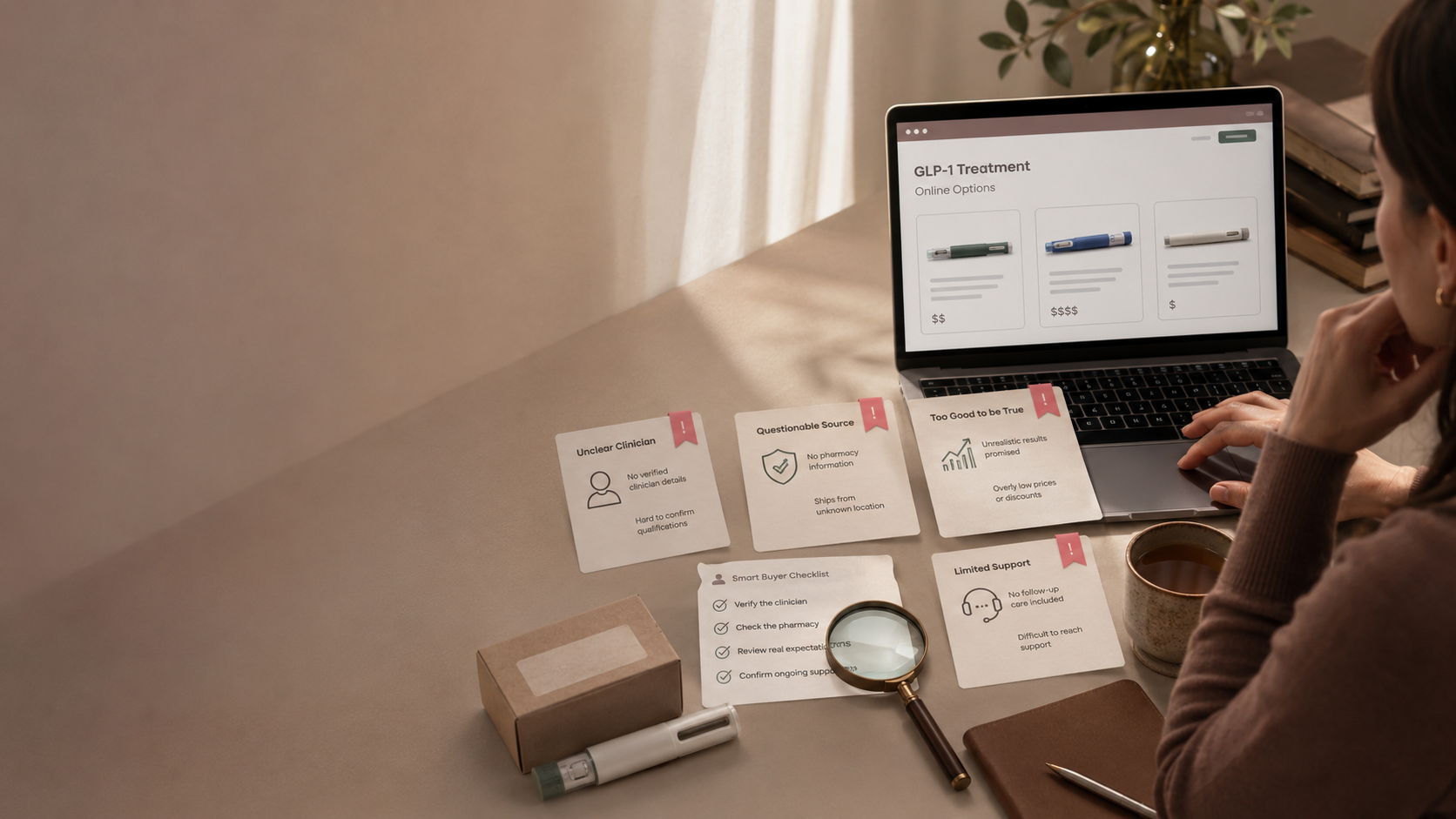
Buying prescription weight-loss medication online can be convenient, particularly for people who have limited access to local obesity care or prefer remote appointments. The difficulty is that legitimate telehealth clinics, licensed pharmacies, aggressive marketers and unlawful drug sellers can appear in the same search results—and may use similarly polished websites.
That does not mean online GLP-1 treatment is inherently questionable. A properly structured telehealth service can connect a patient with a licensed clinician, arrange a clinical evaluation and send an authorized prescription to an appropriately licensed pharmacy. The concern arises when the website makes it difficult to determine who is providing care, what medication is being supplied, where it is coming from or how the patient will receive help after treatment begins.
The distinction has become increasingly consequential. In March 2026, the FDA announced warning letters to 30 telehealth companies over false or misleading claims involving compounded GLP-1 products. The cited concerns included claims implying that compounded products were the same as FDA-approved drugs and marketing that obscured the identity of the actual compounder.
The following red flags when buying GLP-1 medication are therefore not merely signs of poor customer service. Some may indicate that a patient is being asked to purchase a prescription drug without normal clinical, pharmacy or consumer safeguards.
CliniqGuide does not provide medical care or determine whether a medication is appropriate for an individual. A prescription should follow an evaluation by a qualified healthcare professional authorized to treat the patient in their location.
Key takeaways
- Completing a questionnaire should begin a clinical review—not guarantee that a prescription will be issued.
- The service should identify the prescribing clinician and the pharmacy that will dispense or compound the medication.
- Compounded semaglutide or tirzepatide is not an FDA-approved drug and is not an FDA-approved generic equivalent of a branded product.
- Products labeled “research use only” or “not for human consumption” should not be purchased for personal treatment.
- A credible program should explain how patients can contact a clinician about side effects, dosing or a missed dose.
- The full ongoing cost should be visible before enrollment, including membership, medication, shipping, laboratory and cancellation terms.
What should happen when you obtain GLP-1 treatment online?
A responsible online process usually involves several separate parties and decisions.
First, the patient completes an intake covering relevant medical history, current medications, allergies and treatment goals. A licensed clinician then reviews the information and may request an appointment, laboratory work, medical records or additional answers. Because telehealth authority varies by state, the clinician must be properly licensed, registered or otherwise authorized to treat patients where the patient is located.
The clinician—not an automated eligibility quiz or marketing team—decides whether a prescription is appropriate. A prescription may then be sent to a retail, mail-order or compounding pharmacy. The pharmacy dispenses the medication, provides a labeled product and should make a pharmacist available for medication questions.
After treatment begins, the patient should have a defined way to report side effects, ask about dose escalation and receive further clinical review. Some programs also provide nutrition counseling, insurance assistance or weight-management coaching, but those services do not replace medical oversight.
The exact workflow can differ. A service is not necessarily questionable because it uses asynchronous questionnaires, subscriptions or a partner pharmacy. The essential issue is whether the clinical and dispensing steps are genuine, transparent and verifiable.
Red flags versus stronger trust signals
| Area | Warning sign | Stronger trust signal |
| Clinical review | Prescription promised before evaluation | Eligibility depends on clinician review |
| Prescriber | No clinician name, credentials or license information | Prescriber identity and credentials are available |
| Medication | Described only as “GLP-1” or “weight-loss injection” | Active ingredient, formulation and approval status are stated |
| Compounding | Called FDA approved, generic or identical to a brand | Clearly described as a non-FDA-approved compounded preparation |
| Pharmacy | Pharmacy is unnamed or disclosed only after payment | Pharmacy identity and contact information are available |
| Follow-up | Customer support is the only contact | A clinician or pharmacist can address medication questions |
| Marketing | Guaranteed prescription or guaranteed weight loss | Outcomes and eligibility are presented with limitations |
| Pricing | Large headline price with unclear renewal terms | Medication, membership and recurring charges are separated |
| Shipping | Broken packaging, incomplete label or unexplained temperature issue | Written storage, handling and replacement instructions |
| Product source | “Research use only” peptide sold directly to consumers | Prescription filled through a licensed pharmacy |
1. No meaningful evaluation by a licensed healthcare provider
One of the clearest warning signs is a website that sells prescription medication without requiring a prescription or clinical screening. FDA guidance identifies failure to require screening and a prescription from a licensed doctor as a specific telehealth red flag.
An evaluation does not necessarily have to resemble a long in-person appointment. Depending on applicable law and the clinical circumstances, a provider may use video, telephone, secure messaging or asynchronous review. However, the process should collect enough information for a real prescribing decision.
Be cautious when the intake:
- Requests little more than contact information, weight and payment details
- Does not ask about current medications
- Omits relevant medical history or pregnancy status
- Does not identify who reviews the answers
- Immediately directs every applicant to checkout
- Treats a computer-generated result as the final prescribing decision
A short intake is not automatically inadequate, but it should not function merely as a sales funnel.
How to check the clinician
Look for the clinician’s full name and professional designation in your visit records, patient portal or prescription information. Verify the license through the relevant state professional licensing board rather than relying solely on a badge or biography on the company’s website.
Because telehealth authorization may involve a state license, compact or special registration, the relevant question is not simply, “Is this person a doctor or nurse practitioner?” It is, “Is this clinician authorized to treat a patient located in my state?”
2. A guaranteed prescription or automatic approval
A provider may advertise that an evaluation is quick or that many patients qualify. It should not promise that every applicant will receive a prescription.
“Guaranteed approval,” “everyone qualifies” and “prescription or your money back” language suggests that the clinical decision may have been made before the medical history was reviewed. It also creates confusion between paying for an evaluation and buying a predetermined prescription.
A more credible service explains:
- That completing the intake does not ensure eligibility
- Who makes the prescribing decision
- What happens if the patient is not eligible
- Whether consultation or membership fees are refundable
- Whether another treatment may be discussed when a requested drug is unsuitable
Eligibility can depend on the medication’s approved indication, medical history, concurrent treatment, contraindications, potential interactions and the clinician’s judgment. A service that treats prescribing as a certainty is minimizing the purpose of medical review.
3. The medication is described only as a “GLP-1”
“GLP-1” is a drug category or common umbrella term—not a sufficient product description.
Before paying, the patient should be able to determine:
- The active ingredient
- Whether it is an FDA-approved branded drug or a compounded preparation
- The dosage form, such as a pen, vial or tablet
- Whether the quoted price includes the medication
- Whether the medication may change based on availability
- Who manufactures or compounds it
- Which pharmacy will dispense it
Descriptions such as “premium GLP-1,” “medical weight-loss shot” or “semaglutide formula” can conceal important differences.
For example, semaglutide and tirzepatide are different active ingredients. Tirzepatide activates both GIP and GLP-1 receptors, while semaglutide is a GLP-1 receptor agonist. Products also differ in indication, dosage, administration and prescribing information. Zepbound’s current label, for example, identifies tirzepatide as a GIP and GLP-1 receptor agonist and specifies particular approved uses and dosing instructions.
A provider should not leave the medication identity unresolved until an unlabeled package arrives.
4. A compounded product is presented as FDA approved, generic or identical to a brand
Compounding has a legitimate role in healthcare. A compounded drug may be considered when an FDA-approved product cannot meet a particular patient’s medical needs—for example, because a patient requires a different formulation.
However, the compounded preparation itself is not FDA approved. FDA does not review an individual compounded drug for safety, effectiveness and quality before it is marketed. A compounded drug is also not the same regulatory category as an FDA-approved generic drug.
Red-flag claims include:
- “Generic Ozempic”
- “Generic Wegovy”
- “Generic Zepbound”
- “The exact same as the brand”
- “FDA-approved compounded semaglutide”
- “FDA-approved formulation”
- “Identical ingredients and results”
FDA specifically warned telehealth companies in 2026 about implying sameness with approved drugs and obscuring the source of compounded products.
This does not mean that the word “compounded” should automatically disqualify a service. It means the service should accurately disclose the product’s regulatory status, the reason it is being considered and the identity of the licensed compounder.
Ask which form of semaglutide is used
FDA has also raised concerns about compounded products made with semaglutide sodium or semaglutide acetate. These salt forms are different active ingredients from the semaglutide used in approved products, and FDA has stated that it is not aware of a lawful basis for their use in compounding.
A provider or pharmacy should be able to answer a direct question about the active ingredient rather than responding with only “medical-grade semaglutide.”
5. The dispensing or compounding pharmacy is unidentified
A telehealth company may coordinate the treatment, but a pharmacy generally fills the prescription. Consumers should know which pharmacy is responsible for the medication.
FDA advises consumers to use state-licensed pharmacies and provides links to state board databases. It says that a listed pharmacy should also require a prescription, provide a U.S. physical address and telephone number, and have a licensed pharmacist available.
Warning signs include:
- “Partner pharmacy” with no name
- Refusal to identify the pharmacy before payment
- A pharmacy name that cannot be found in a state license database
- No pharmacist contact information
- A label showing a different pharmacy from the one disclosed
- A pharmacy address that appears incomplete or incorrect
- Medication carrying only the telehealth company’s branding
The National Association of Boards of Pharmacy also offers a Safe Site Search Tool and recommends checking whether an online pharmacy is verified or appears on its Not Recommended List. NABP says verified pharmacies accept valid prescriptions, maintain appropriate licenses and provide accessible patient-care contact information.
Licensure does not prove that every transaction or medication is appropriate. It is nevertheless a basic verification step. If the pharmacy cannot be identified or its license cannot be confirmed, do not assume the telehealth brand’s reputation fills that gap.
6. The product says “research use only” or “not for human consumption”
This language is not a harmless technicality.
FDA has warned companies that sold unapproved semaglutide, tirzepatide or retatrutide products falsely labeled “for research purposes” or “not for human consumption” while also providing consumers with human-use dosing instructions. FDA advises consumers not to purchase these products because their quality is unknown and they may be harmful.
These products may be promoted through:
- Peptide websites
- Social-media accounts
- Fitness or bodybuilding communities
- Online marketplaces
- Sellers describing the product as a “lab chemical”
- Vendors that sell a vial without a prescription or pharmacy label
A disclaimer does not convert an unknown research product into a prescription medication. Do not attempt to reconstitute or inject a research-labeled peptide for personal treatment.
Experimental drugs such as retatrutide should also not be confused with currently approved prescription GLP-1 treatments. FDA states that retatrutide has not been found safe and effective for any condition and cannot lawfully be used in compounding.
7. There is no clinical follow-up or adverse-event process
GLP-1 treatment is not only a transaction for a monthly shipment. Patients may need help with dose escalation, administration, persistent gastrointestinal effects, other medications, treatment interruptions or a change in medical status.
FDA identifies the absence of a licensed doctor who can answer questions after medication is received as a telehealth red flag.
Before enrolling, determine:
- How to contact a clinician
- Whether communication is asynchronous, scheduled or on demand
- Typical response arrangements for medication questions
- Who reviews side effects
- Whether dose changes require clinical approval
- What happens if a dose is missed
- What to do if the medication arrives damaged
- How urgent problems are directed to appropriate care
- Whether follow-up visits are included or separately charged
A general customer-service inbox is not the same as medical follow-up. Customer support may be able to fix a shipment or billing issue, but it should not independently advise a patient to change a dose.
Patients and healthcare professionals may also report serious reactions, medication errors and product-quality concerns through FDA’s MedWatch program.
8. Unrealistic or guaranteed weight-loss results
Clinical trial averages do not predict an individual patient’s result. Outcomes can vary with the drug, dose, treatment duration, underlying health, adherence, tolerability and accompanying lifestyle intervention.
Be cautious of claims such as:
- “Lose 20 pounds in 30 days”
- “Guaranteed 15% weight loss”
- “Works for everyone”
- “No diet or activity changes needed”
- “Zero side effects”
- “Permanent weight loss”
- “Stronger than the brand”
- Dramatic before-and-after images presented without context
Current prescribing information for approved weight-management drugs describes use alongside reduced-calorie eating and increased physical activity. Trials also use defined populations, dose-escalation schedules and clinical monitoring rather than unrestricted consumer use.
A provider may accurately summarize published study results, but it should identify the medication, dose, study duration and population—and make clear that the result is not guaranteed for every patient.
9. The headline price obscures the real recurring cost
A low introductory figure may apply only to the first month, consultation, membership or lowest dose. It may not include medication.
Subscription billing is not itself a red flag. Many legitimate telehealth services use monthly memberships. The concern is whether consumers can understand the recurring obligation before entering payment information.
Review the offer for:
- Introductory versus renewal price
- Membership fee
- Medication charge
- Whether price changes with dose
- Consultation or follow-up fees
- Laboratory costs
- Shipping or supply charges
- Insurance-processing fees
- Minimum commitment
- Auto-renewal date
- Cancellation method and deadline
- Refund policy if no prescription is issued
- Charges that continue while treatment is paused
The FTC advises consumers to determine exactly what they are agreeing to, how long a promotion lasts and how to cancel before a subscription renews. It also warns that renewal prices may be higher than promotional rates.
A useful pricing test
Before enrolling, try to complete this sentence:
“Starting on [date], I will be charged [amount] every [billing period] for [services and medication], and I can stop the next charge by [cancellation process].”
If the website does not provide enough information to fill in each blank, request written clarification.
10. The medication arrives with damaged packaging, labeling discrepancies or unexplained temperature problems
Inspect the shipment before using it.
FDA has reported fraudulent compounded semaglutide and tirzepatide labels, including labels naming pharmacies that did not actually prepare the product. It has also warned about products arriving with broken packaging, missing instructions, spelling errors or incorrect pharmacy addresses.
Check for:
- Your name and prescription information
- Medication name and concentration
- Directions for use
- Pharmacy name and contact details
- Prescriber information where applicable
- Lot or batch information
- Beyond-use or expiration date
- Tamper evidence
- Written storage instructions
- Consistency between the vial, carton and patient portal
Do not assume that a professionally printed label is authentic. FDA has documented fraudulent labels carrying the names of real pharmacies that did not make the products.
Shipping requirements depend on the product and its labeling. Some approved products have limited room-temperature storage allowances, while other shipments may need to remain refrigerated. FDA has received complaints about certain compounded GLP-1 products arriving warm or with inadequate cooling and recommends not using a product that arrives warm when refrigeration was required.
Contact the dispensing pharmacy for written guidance rather than relying on a social-media comment or guessing whether the medication remains usable.
How to verify an online GLP-1 provider before paying
Use five separate checks. A convincing answer in one category does not compensate for missing information in another.
1. Verify the clinical service
Confirm:
- The name of the medical practice providing care
- The clinician’s identity and credentials
- Authorization to treat patients in your state
- How the clinical evaluation occurs
- That a prescription is not guaranteed
- How follow-up care is provided
2. Verify the pharmacy
Confirm:
- Full legal pharmacy name
- Physical location
- State pharmacy license
- Telephone number
- Access to a pharmacist
- Whether it is a retail pharmacy, traditional compounding pharmacy or FDA-registered outsourcing facility
FDA recommends checking the pharmacy through the applicable state board database. NABP’s verification tools can provide an additional check for online sellers.
3. Verify the medication
Ask:
- What is the active ingredient?
- Is this an FDA-approved product or a compounded preparation?
- What brand or compounder will appear on the label?
- Could the product change from one shipment to another?
- What concentration will be supplied?
- How will the dose be measured and administered?
- Does the preparation contain additional ingredients?
FDA has received reports of dosing errors with compounded injectable semaglutide, including errors caused by patients measuring the wrong amount and healthcare professionals miscalculating doses. Some cases required hospitalization.
For a vial-based medication, instructions should distinguish clearly between milligrams, milliliters and syringe units. Do not proceed if the prescribed dose cannot be reconciled with the label and syringe markings.
4. Verify the full cost
Request a written breakdown of:
- Initial payment
- Regular recurring payment
- Medication cost
- Membership cost
- Dose-related price changes
- Laboratory or consultation charges
- Shipping
- Cancellation timing
- Refund terms
Save a copy of the terms shown at checkout.
5. Verify the follow-up plan
Determine who will handle:
- Side effects
- Dose escalation
- Medication interactions
- Pregnancy or surgery notifications
- Shipment problems
- Treatment interruptions
- Refills
- Transfer of records
- Cancellation
A program should be able to explain these processes before enrollment—not only after a problem occurs.
Why screening and follow-up matter
GLP-1 and related medications commonly cause gastrointestinal effects. In adult Wegovy trials, nausea, diarrhea, vomiting, constipation and abdominal pain were among the commonly reported reactions.
Approved semaglutide and tirzepatide labeling also contains important warnings and precautions. Depending on the product and patient, relevant issues may include pancreatitis, gallbladder disease, severe gastrointestinal symptoms, dehydration and kidney problems, serious allergic reactions, hypoglycemia when used with certain diabetes medicines and pregnancy considerations. Both Wegovy and Zepbound are contraindicated in people with a personal or family history of medullary thyroid carcinoma or multiple endocrine neoplasia syndrome type 2.
This is why a clinician should know about the patient’s medical history, other prescriptions and changes in health status. The purpose is not to create unnecessary barriers. It is to determine whether treatment is appropriate, choose a suitable product and dose, and provide a route for managing problems.
Patients should seek prompt medical guidance for severe or persistent symptoms. Product labeling for tirzepatide, for example, advises contacting a healthcare provider for severe or continuing stomach symptoms, persistent nausea, vomiting or diarrhea, and possible gallbladder symptoms. It directs patients to stop treatment and obtain immediate help for symptoms of a serious allergic reaction and to contact a clinician promptly for severe, persistent abdominal pain that may indicate pancreatitis.
Specific instructions vary by medication. Follow the prescribing clinician’s advice and the medication’s official patient labeling.
Who may appreciate online GLP-1 care?
Online treatment may appeal to adults who:
- Prefer remote appointments
- Have difficulty accessing a local obesity-medicine specialist
- Want prescription, pharmacy and follow-up services coordinated through one platform
- Are comfortable using a patient portal
- Can provide accurate medical information and relevant records
- Understand that a clinician may decide not to prescribe the requested medication
It may be less suitable for someone who:
- Needs urgent or emergency care
- Requires a physical examination or testing that cannot be completed remotely
- Is uncomfortable self-administering or measuring medication
- Cannot obtain clear answers about the clinician, pharmacy or formulation
- Needs close coordination across several complex medical conditions
- Has received a product with questionable labeling or sourcing
A legitimate online provider should also be willing to redirect a patient to in-person care when remote treatment is not appropriate.
Questions to ask before enrolling
- Who will review my medical history and make the prescribing decision?
- Is that clinician authorized to treat patients in my state?
- Does completing the intake guarantee a prescription?
- What happens to my payment if I am not eligible?
- What exact medication and active ingredient are being considered?
- Is the product FDA approved or compounded?
- If compounded, why is a compounded preparation being considered?
- Which pharmacy will fill the prescription?
- Can I verify that pharmacy before paying?
- Will the pharmacy name appear on the medication label?
- Does the advertised price include medication?
- Is the price introductory or ongoing?
- Can the price increase with the dose?
- Are shipping, consultations, supplies and laboratory work included?
- How do I contact a clinician about side effects?
- Who authorizes dose changes?
- What happens if a shipment arrives late, damaged or warm?
- How do I cancel, and when must I cancel to prevent another charge?
- Will I receive a copy of my prescription and clinical records?
- How is my health and payment information handled?
What to do if you have already received suspicious medication
Do not inject or ingest a product merely because it has already been paid for.
Take photographs of the vial, carton, shipping materials and label. Save the prescription, invoice, website description and all communications. Contact the named pharmacy using independently verified contact information—not only a telephone number printed on a questionable label.
Ask the pharmacy to confirm:
- That it filled the prescription
- The patient and prescription details
- The medication and concentration
- The lot or batch
- Storage requirements
- Whether the packaging is consistent with its products
Contact the prescribing clinician separately. If the pharmacy denies producing the medication, the label is inconsistent or the product says “research use only,” do not use it.
Serious reactions, medication errors and suspected product-quality problems can be reported to FDA through MedWatch. Suspicious online pharmacies may also be reported through FDA or NABP reporting channels.
For urgent symptoms, contact an appropriate medical service rather than waiting for a standard customer-support response.
The bottom line
The most useful tips for buying GLP-1 medication are not based on the appearance of the website, the number of testimonials or the size of the discount.
Verify five things independently:
- The clinician
- The prescription
- The medication
- The pharmacy
- The ongoing financial and follow-up arrangement
A legitimate commercial telehealth service should be able to answer reasonable questions about all five. It may use subscriptions, asynchronous care or partner pharmacies without being problematic. What matters is whether the clinical decision is genuine, the medication source is traceable, the product is described accurately and the patient has access to qualified help after the sale.
When essential information remains hidden—or when the seller promises a prescription, guaranteed results or a research-labeled product—the appropriate next step is not to take a chance. It is to stop and verify before paying or using the medication.