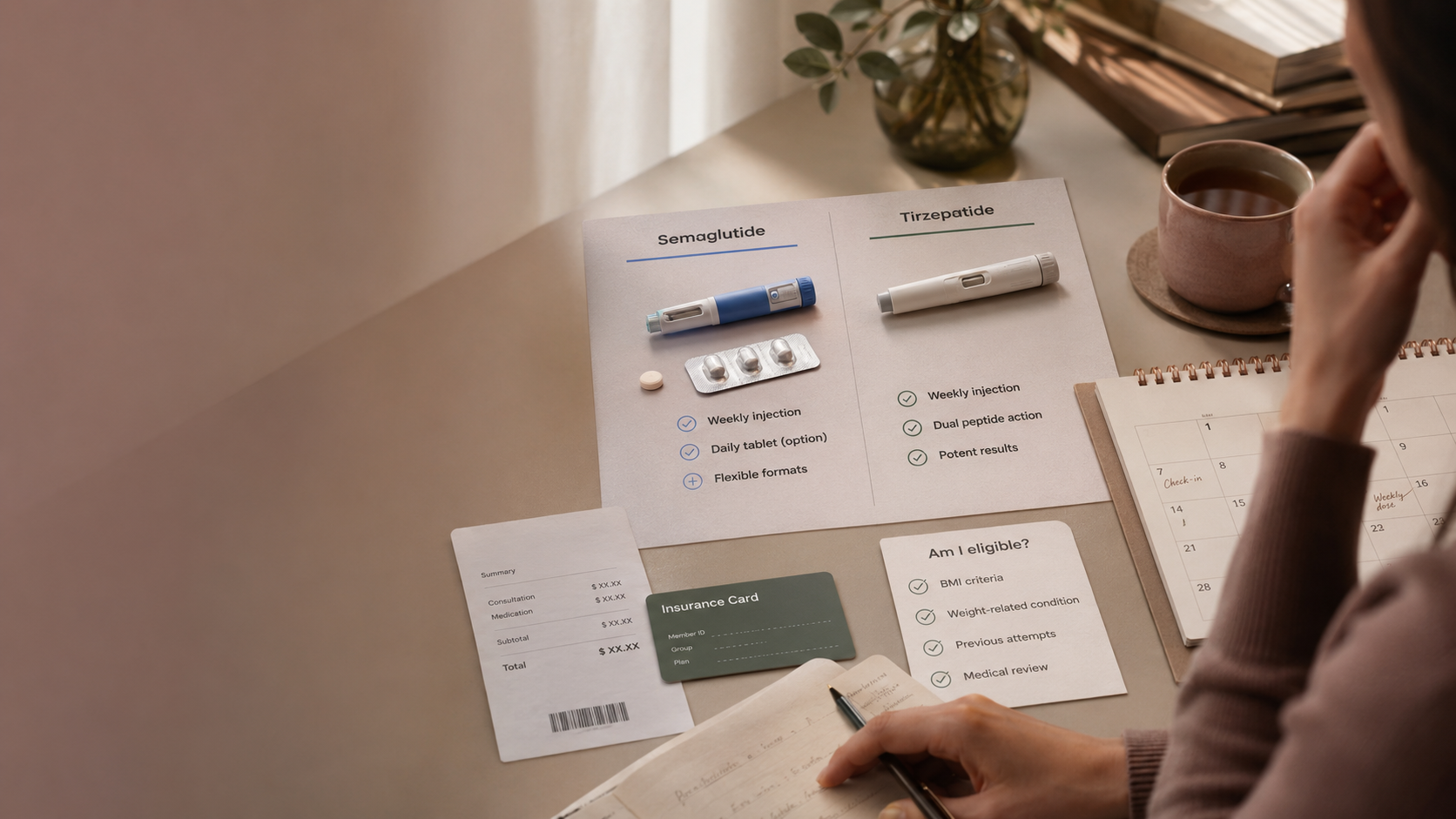
Choosing between semaglutide and tirzepatide involves more than comparing two weight-loss percentages. The medications act differently, appear under several brand names and may come with very different out-of-pocket costs depending on the prescribed product, dose, insurance plan and provider.
The comparison has also changed recently. Semaglutide is now available for weight management as both a weekly Wegovy injection and a daily Wegovy tablet, while a higher-dose Wegovy HD injection has added another semaglutide option. Tirzepatide for weight management remains a weekly injection sold as Zepbound, with several device and dose configurations.
Trial results matter, but so do cardiovascular history, obstructive sleep apnea, age, pregnancy plans, gastrointestinal conditions, other medications and the practical question of whether treatment remains affordable after the introductory month.
CliniqGuide does not provide medical care, diagnose conditions or prescribe medication. A prescription requires evaluation by a qualified healthcare professional, and completing an online intake does not guarantee approval.
Key takeaways
- Tirzepatide and semaglutide are not the same type of medication. Semaglutide activates the GLP-1 receptor, while tirzepatide activates both GIP and GLP-1 receptors.
- Tirzepatide produced greater average weight reduction in the principal direct trial, but that study compared injected tirzepatide with Wegovy doses up to 2.4 mg. It did not evaluate the newer 7.2 mg Wegovy HD dose or daily Wegovy tablets.
- Semaglutide currently offers more administration choices. Wegovy may be taken as a weekly injection or a daily tablet. Zepbound is administered as a weekly injection.
- Eligibility can differ because the branded products have different FDA-approved indications. Wegovy has cardiovascular-risk, weight-management and certain liver-disease indications; Zepbound has weight-management and obstructive-sleep-apnea indications.
- The advertised telehealth price may not be the total price. Some programs charge a membership in addition to medication, while manufacturer self-pay pharmacies may fill an existing prescription without a clinical membership.
- Compounded semaglutide and tirzepatide are not FDA-approved substitutes for Wegovy or Zepbound. Their availability has become more restricted since the FDA declared the national shortages resolved and increased enforcement against mass-marketed compounded GLP-1 products.
Semaglutide vs. tirzepatide at a glance
| Comparison point | Semaglutide | Tirzepatide |
| How it works | GLP-1 receptor agonist | Dual GIP and GLP-1 receptor agonist |
| Main weight-management brand | Wegovy | Zepbound |
| Other common brands | Ozempic and Rybelsus, primarily associated with type 2 diabetes indications | Mounjaro, primarily associated with type 2 diabetes |
| Weight-management administration | Weekly injection or daily tablet | Weekly injection |
| Typical injected starting dose | Wegovy 0.25 mg weekly | Zepbound 2.5 mg weekly |
| Adult weight-management maintenance doses | Wegovy injections are usually 1.7 or 2.4 mg; selected adults may advance to 7.2 mg. Wegovy tablet maintenance dose is 25 mg daily | Zepbound 5, 10 or 15 mg weekly |
| Selected additional indications | Reduction of major cardiovascular events in certain adults; certain noncirrhotic MASH; Wegovy injection also has an adolescent obesity indication | Moderate-to-severe obstructive sleep apnea in adults with obesity |
| Head-to-head result | Average 13.7% reduction at 72 weeks with 1.7 or 2.4 mg injection | Average 20.2% reduction at 72 weeks with 10 or 15 mg injection |
| Common treatment concerns | Gastrointestinal effects; strict tablet timing if using oral Wegovy | Gastrointestinal effects; temporary oral-contraceptive precautions during initiation and dose increases |
FDA-approved indications and dosing come from the current prescribing information. The weight-loss percentages come from a controlled clinical trial and should not be interpreted as a prediction for an individual patient.
How semaglutide and tirzepatide differ
Semaglutide mimics activity at the glucagon-like peptide-1, or GLP-1, receptor. Among its effects, it influences appetite regulation, slows gastric emptying and supports glucose-dependent insulin secretion.
Tirzepatide activates the GLP-1 receptor and the glucose-dependent insulinotropic polypeptide, or GIP, receptor. This dual activity is the principal pharmacologic difference between tirzepatide and semaglutide. It does not automatically establish which medication is appropriate for a particular person, but it helps explain why their dosing and clinical results are not identical.
Both medications are intended to accompany nutrition and physical-activity changes rather than replace them. Both are generally considered long-term treatments when they remain effective, tolerated, medically appropriate and financially sustainable.
Brand names matter because the approved uses are different
Consumers frequently use active-ingredient and brand names interchangeably, but insurers, pharmacies and clinicians do not.
Semaglutide brands
Wegovy is the principal semaglutide brand approved for chronic weight management. As of July 2026, it is available as an injection and a tablet. Wegovy also carries additional indications, including reduction of major adverse cardiovascular events in certain adults with established cardiovascular disease and overweight or obesity. Wegovy injection has an indication for certain patients with noncirrhotic metabolic dysfunction-associated steatohepatitis, or MASH, and may be used for obesity in patients aged 12 and older.
Ozempic and Rybelsus are other familiar semaglutide brands associated primarily with type 2 diabetes indications. A clinician may sometimes prescribe a medication off label, but off-label use is different from an FDA-approved weight-management indication and may affect insurance coverage.
Tirzepatide brands
Zepbound is the tirzepatide brand approved for long-term weight reduction in qualifying adults. It is also approved to treat moderate-to-severe obstructive sleep apnea in adults with obesity.
Mounjaro contains tirzepatide but is primarily the diabetes-labeled brand. As with semaglutide, the active ingredient may be the same while the approved indication, dosing context, insurance coverage and packaging differ.
Ozempic vs. Zepbound is not an exact weight-loss comparison
“Ozempic vs. Zepbound” is a popular search, but the more equivalent FDA-labeled weight-management comparison is usually Wegovy vs. Zepbound.
Ozempic is a semaglutide product associated primarily with diabetes treatment. Zepbound is a tirzepatide product specifically labeled for weight management and obesity-related obstructive sleep apnea. Comparing only the brand names without checking indication and dose can therefore be misleading.
What treatment is typically like
Wegovy injection
Wegovy injection starts at 0.25 mg once weekly. The standard schedule increases the dose approximately every four weeks to 0.5 mg, 1 mg and 1.7 mg. The usual adult weight-management maintenance dose is 1.7 or 2.4 mg weekly.
For selected adults who have tolerated 2.4 mg for at least four weeks and for whom additional weight reduction is clinically indicated, the dose may be increased to Wegovy HD 7.2 mg weekly. Escalation may be delayed when a dose is not well tolerated.
Wegovy tablets
The daily Wegovy tablet offers an alternative for adults who would prefer not to inject medication, but it requires a more exact morning routine.
The tablet is taken on an empty stomach with no more than four ounces of water. The patient must then wait at least 30 minutes before eating, drinking anything else or taking another oral medication. The current escalation schedule moves from 1.5 mg to 4 mg, then 9 mg and finally the 25 mg daily maintenance dose.
A daily tablet may sound simpler than a weekly injection, but it can be less convenient for someone who takes other morning medication, works irregular shifts or struggles to maintain the fasting interval.
Zepbound injection
Zepbound starts at 2.5 mg once weekly for four weeks. That is an initiation dose rather than an approved maintenance dose.
The dose may then be raised to 5 mg and, when appropriate, increased in 2.5 mg increments after at least four weeks at the current dose. Approved weight-management maintenance doses are 5, 10 or 15 mg weekly. The maximum recommended dose is 15 mg.
Zepbound comes in several presentation types, including single-dose devices, vials and a multi-dose KwikPen. Device availability and insurance eligibility may differ even when the medication and dose are the same.
What does the direct comparison show?
The most relevant direct trial enrolled 751 adults with obesity, or overweight plus an obesity-related complication, who did not have diabetes. Participants received the maximum tolerated dose of injected tirzepatide—10 or 15 mg—or injected semaglutide—1.7 or 2.4 mg—for 72 weeks.
Average body-weight reduction was:
- 20.2% with tirzepatide
- 13.7% with semaglutide
Participants taking tirzepatide were also more likely to reach weight-reduction thresholds of 10%, 15%, 20% and 25%. Gastrointestinal adverse events were common in both groups and occurred primarily during dose escalation. Gastrointestinal effects leading to discontinuation were reported more frequently with semaglutide in this trial: 5.6% versus 2.7% with tirzepatide.
These findings make tirzepatide’s average weight-loss advantage clinically relevant, but they do not settle every treatment decision.
The study was open label, funded by Eli Lilly and limited to adults without diabetes. It also compared tirzepatide with the established 1.7 and 2.4 mg Wegovy doses. It did not test the subsequently approved 7.2 mg Wegovy HD dose or daily Wegovy tablets. Results from a controlled trial also cannot predict how much weight a particular patient will lose or how long that person will remain on treatment.
General eligibility considerations
Healthcare professionals commonly consider weight-management medication for adults with a body mass index of at least 30, or at least 27 with a weight-related health problem such as hypertension or type 2 diabetes. BMI is a screening tool rather than a complete assessment, and a clinician may also consider weight history, previous treatment, current medications, metabolic health, physical function and treatment goals.
Meeting a BMI threshold does not guarantee a prescription or insurance approval.
Factors that may influence the choice
A clinician may consider:
- Whether the patient has established cardiovascular disease
- Whether obesity-related obstructive sleep apnea is present
- Type 2 diabetes and current glucose-lowering medication
- History of pancreatitis, gallbladder disease or severe gastrointestinal symptoms
- Kidney health and risk of dehydration
- Diabetic retinopathy
- Current oral medications
- Pregnancy or plans to become pregnant
- Use of oral hormonal contraception
- Previous response to GLP-1 medication
- Ability to follow a daily fasting tablet routine
- Insurance coverage and realistic long-term affordability
Important contraindications
Both Wegovy and Zepbound carry boxed warnings concerning thyroid C-cell tumors observed in rodents. It is unknown whether either medication causes medullary thyroid carcinoma in humans.
Both are contraindicated in people with a personal or family history of medullary thyroid carcinoma or Multiple Endocrine Neoplasia syndrome type 2, as well as those with a serious hypersensitivity to the medication or its ingredients.
Neither medication should be combined with another product containing the same active ingredient or with another GLP-1 receptor agonist unless a qualified clinician has provided a medically appropriate transition plan.
How online treatment usually works
A legitimate online program generally follows the same clinical sequence as other prescription care, although the communication may occur through forms, messaging, phone or video:
- Online intake: The patient provides medical history, weight information, current medications and treatment goals.
- Clinical review: A clinician licensed to treat the patient reviews the information and may request clarification, records or laboratory testing.
- Consultation: Some states or clinical situations require a live phone or video visit.
- Eligibility decision: The clinician decides whether medication is appropriate. A prescription is not guaranteed.
- Insurance or cash-pay selection: The provider may submit prior authorization, send the prescription to a local pharmacy or route it to a manufacturer-direct pharmacy.
- Fulfillment: Medication may be picked up locally or shipped, depending on the product and payment pathway.
- Dose escalation and follow-up: The clinician evaluates tolerability, response and whether to continue, delay or change the dose.
- Ongoing monitoring: Patients need a reliable way to report side effects, medication changes, upcoming procedures or pregnancy.
Ro, for example, states that a healthcare provider reviews the online visit and determines whether treatment may be appropriate; its insurance support does not guarantee coverage. Mochi likewise states that medication is prescribed at provider discretion.
Where semaglutide and tirzepatide are available
Patients may obtain an appropriate prescription through an in-person primary-care clinician, endocrinologist, obesity-medicine specialist or licensed telehealth provider.
The fulfillment and support model can vary considerably.
| Access model | What it commonly includes | Cost issue to verify |
| Existing clinician plus local pharmacy | Clinical visit and prescription; pharmacy dispenses medication | Office copay, medication copay, prior authorization and local stock |
| Manufacturer-direct pharmacy | Cash-pay fulfillment of a valid prescription, often with delivery | Medication price only; the pharmacy does not replace the prescribing clinician |
| Membership telehealth | Intake, clinician access, insurance assistance and follow-up | Medication may be charged separately from membership |
| Bundled cash-pay telehealth | Evaluation, medication and shipping in one quoted price | Whether the product is FDA approved or compounded; whether price rises with dose |
| Compounding-focused program | Patient-specific prescription and compounded preparation | Pharmacy identity, legal basis for compounding, concentration, supplies and regulatory status |
Examples of current provider structures
Ro currently advertises access to FDA-approved options including Wegovy tablets and Zepbound KwikPen. Its pricing page separates the clinical membership from medication: $39 to start, with ongoing membership advertised as low as $74 per month when an annual plan is prepaid. The monthly membership option is higher, and medication is an additional charge.
Mochi advertises access to brand-name prescriptions and compounded options. Its own materials list membership separately and describe compounded semaglutide and tirzepatide as provider-discretion products that are not interchangeable with FDA-approved medication. Because compounded-GLP-1 policy is changing quickly, availability and pricing should be reconfirmed immediately before enrollment.
NovoCare Pharmacy and LillyDirect offer manufacturer-run fulfillment pathways for patients with valid prescriptions. These services can reduce the medication price for qualifying cash-paying patients, but they do not eliminate the need for a prescribing clinician or clinical follow-up.
Semaglutide vs. tirzepatide cost
The price visible in an advertisement may be a starting dose, introductory month, membership fee or medication-only price. Consumers should identify the ongoing total at the dose they are likely to use.
Manufacturer pricing snapshot
The following figures were verified from manufacturer sources on July 29, 2026. They are not guaranteed future prices, and eligibility requirements apply.
| Product and payment pathway | Advertised price | Important qualification |
| Wegovy injection list price | $1,349.02 per package | List price before rebates, insurance or savings programs |
| Wegovy injection, new self-pay patients | $199 per month for the first two fills | Applies to 0.25 and 0.5 mg under the current limited offer |
| Wegovy injection, standard self-pay | $349 per month | Current standard offer for 0.25 through 2.4 mg |
| Wegovy HD 7.2 mg, self-pay | $399 per month | Higher than standard injected doses |
| Wegovy tablet 1.5 mg | $149 per month | Starting dose |
| Wegovy tablet 4 mg | $149 limited offer; normally $199 | Current limited offer scheduled to end August 31, 2026 |
| Wegovy tablet 9 or 25 mg | $299 per month | Includes the 25 mg maintenance dose |
| Zepbound 2.5 mg KwikPen or vials | $299 per month | Starting dose, not an approved maintenance dose |
| Zepbound 5 mg | $399 per month | Approved maintenance dose |
| Zepbound 7.5–15 mg | $449 per month | Requires compliance with current refill terms for the lowest price |
| Zepbound higher-dose late-refill price | Up to $699 per month | Current terms increase the price if eligible higher doses are not refilled within 45 days |
| Zepbound single-dose pen list price | Approximately $1,086.37 per fill | Wholesale acquisition cost; actual pharmacy price may differ |
Wegovy prices and terms come from Novo Nordisk’s current price guide and NovoCare pages. Zepbound prices come from LillyDirect and Lilly pricing disclosures.
A lower starting price does not establish the cheaper treatment
A patient beginning Wegovy injection might pay $199 for each of the first two fills and then $349. A patient beginning Zepbound may pay $299 at 2.5 mg, $399 at 5 mg and $449 at higher doses if current refill conditions are met.
The longer-term comparison therefore depends on:
- The formulation and dose prescribed
- Whether the patient qualifies for a manufacturer offer
- Whether the offer expires
- Whether the patient refills on schedule
- The cost of the clinical program
- Insurance premiums, deductible and copayment
- Laboratory or consultation charges
- Shipping and injection-supply costs
- Whether the medication changes during treatment
Patients should request a six- or twelve-month cost estimate rather than relying on the checkout price for month one.
Insurance, Medicare and cash payment
Commercial insurance coverage varies by plan and indication. A plan may cover one obesity medication but exclude another, require prior authorization or cover a diabetes-labeled brand only for type 2 diabetes.
Manufacturer savings offers currently advertise copays as low as $25 for some commercially insured patients, but maximum savings limits apply. Government-program beneficiaries are generally excluded from commercial savings cards.
A significant 2026 change affects Medicare. The Medicare GLP-1 Bridge began July 1, 2026 and provides qualifying Part D beneficiaries with selected weight-management GLP-1 products for a $50 monthly copay through December 31, 2027. The covered products currently include Wegovy injection or tablets and Zepbound KwikPen; single-dose Zepbound pens and vials are not included. Eligibility and prior authorization are required, and the $50 does not count toward the standard Part D deductible or out-of-pocket calculation.
Medicaid coverage varies by state and indication. Consumers should confirm coverage directly with their plan rather than relying on a clinic’s general statement that it “accepts insurance.”
Side effects and the treatment experience
The most common adverse effects of both medications are gastrointestinal. Current labeling includes nausea, diarrhea, vomiting, constipation, abdominal pain and indigestion among the commonly reported reactions. Symptoms often become more noticeable during dose escalation.
A tolerable treatment plan is not necessarily the one that reaches the highest dose most quickly. Clinicians may delay escalation or select a lower maintenance dose when side effects or other clinical factors justify it.
Both labels also address less common but potentially serious concerns, including:
- Pancreatitis
- Gallbladder disease
- Kidney injury related to dehydration
- Severe gastrointestinal reactions
- Serious hypersensitivity reactions
- Hypoglycemia when combined with insulin or an insulin secretagogue
- Diabetic-retinopathy complications in relevant patients
- Pulmonary aspiration risk during general anesthesia or deep sedation
Both medications are not recommended for patients with severe gastroparesis. Patients should tell surgical, dental and anesthesia teams that they use a medication that delays gastric emptying.
A tirzepatide-specific contraception consideration
Zepbound can affect absorption of oral hormonal contraceptives, particularly when treatment starts and after dose escalation. Its label advises patients using oral hormonal contraception to switch to a non-oral method or add a barrier method for four weeks after starting treatment and for four weeks after each dose increase.
Pregnancy considerations
Weight-loss treatment is not recommended during pregnancy. Wegovy labeling advises discontinuation at least two months before a planned pregnancy because semaglutide remains in the body for an extended period. Zepbound should be discontinued when pregnancy is recognized. Pregnancy plans should be discussed before treatment begins.
Severe or persistent abdominal pain, repeated vomiting with inability to keep fluids down, symptoms of a serious allergic reaction, difficulty breathing or swallowing, or a neck lump or persistent hoarseness warrant prompt medical attention.
FDA-approved medication versus compounded preparations
An FDA-approved Wegovy or Zepbound product has undergone FDA review for quality, safety and effectiveness for its labeled use. A compounded semaglutide or tirzepatide preparation has not been individually approved or reviewed by the FDA.
Compounded drugs can serve legitimate patient-specific needs, but they are not generics and should not be described as identical or interchangeable with an FDA-approved brand.
The national shortages of semaglutide and tirzepatide injections have been declared resolved. As a result, the broad shortage-based pathway that supported large-scale production of compounded copies has narrowed. Federal law may still permit patient-specific compounding in limited circumstances—for example, when a prescriber documents that a formulation change produces a significant difference for an identified patient—but lower price alone does not establish that exception.
In 2026, the FDA warned numerous telehealth companies about misleading compounded-GLP-1 marketing and highlighted fraudulent products, false pharmacy labels, unapproved salt forms and dosing errors.
Before accepting a compounded product, ask:
- Which licensed pharmacy prepares it?
- Is the prescription based on a documented patient-specific need?
- What is the exact concentration and dose in milligrams?
- Is the product semaglutide or a semaglutide salt?
- Are syringes and dosing instructions included?
- Who should be contacted about dosing questions or an adverse reaction?
- Why is the compounded formulation clinically preferable for this patient?
Who may find semaglutide worth discussing?
Semaglutide may be worth discussing for an adult who:
- Prefers the possibility of an FDA-approved daily tablet
- Has established cardiovascular disease and may fall within Wegovy’s cardiovascular-risk indication
- Requires consideration of an indication specific to Wegovy, such as qualifying MASH
- Has previously responded well to semaglutide
- Has insurance that covers Wegovy but not Zepbound
- Finds NovoCare’s current self-pay price more sustainable
The tablet may not suit someone unable to follow its strict fasting and medication-timing instructions. Injected semaglutide may not appeal to someone unwilling to use a weekly injection.
Who may find tirzepatide worth discussing?
Tirzepatide may be worth discussing for an adult who:
- Places substantial importance on the greater average weight reduction observed in the direct 72-week trial
- Has obesity and moderate-to-severe obstructive sleep apnea
- Prefers a once-weekly medication
- Has coverage for Zepbound but not Wegovy
- Has used semaglutide without sufficient response or tolerability and is being evaluated for a clinician-directed change
It may be less convenient for someone who strongly prefers an oral treatment or who relies on an oral hormonal contraceptive and does not want temporary additional contraceptive precautions during dose escalation.
These are discussion points rather than prescribing recommendations.
Telehealth warning signs
Be cautious when a clinic or seller:
- Guarantees approval or a prescription
- Provides medication without a licensed clinical evaluation
- Cannot name the dispensing pharmacy
- Uses the clinic’s brand on a vial without clearly identifying the actual compounding pharmacy
- Describes compounded medication as FDA approved, generic or identical to Wegovy or Zepbound
- Sells a “research-use-only” peptide for self-injection
- Quotes only the starting-dose or first-month price
- Does not explain whether membership, medication, shipping, supplies and labs are separate
- Automatically increases the dose without assessing side effects
- Provides no process for contacting a clinician
- Makes cancellation or recurring-billing terms difficult to find
- Promises a precise amount of weight loss
FDA enforcement actions in 2025 and 2026 have specifically addressed misleading equivalence claims and unclear sourcing in compounded-GLP-1 advertising.
Questions to discuss with a clinician
Medical suitability
- Which product and indication are you considering for me?
- Does my medical history make one medication less appropriate?
- Do I have any contraindication involving medullary thyroid carcinoma or MEN 2?
- How do my gastrointestinal, gallbladder, pancreatic or kidney history affect the choice?
- Could either medication interact with my current diabetes or oral medications?
- Do I need an eye examination or additional monitoring because of diabetes?
- What should I do if I am planning pregnancy?
- How does tirzepatide affect my oral contraceptive?
- What should I do before surgery, dental sedation or another procedure?
Treatment expectations
- Which dose would I start with?
- How often will you reassess tolerability before increasing it?
- What response would lead you to continue, change or discontinue treatment?
- How can I contact a clinician about side effects?
- What is the plan if the medication is unavailable?
- What follow-up is included after I reach a maintenance dose?
Cost and provider terms
- Is the quoted price for the membership, medication or both?
- Which dose does the advertised medication price cover?
- Will the price rise as my dose rises?
- Is the first price introductory?
- Is insurance billed for the consultation, medication or neither?
- Who handles prior authorization and appeals?
- Are laboratory tests, supplies and shipping included?
- Which pharmacy fills the prescription?
- What happens financially if I am not eligible?
- How do I pause or cancel, and when must cancellation occur to prevent another charge?
The practical conclusion
Tirzepatide produced greater average weight reduction than injected semaglutide in the most relevant direct trial. That is useful evidence, but it does not make tirzepatide the universal choice.
Semaglutide now provides an FDA-approved oral option, a higher-dose injectable option and several additional labeled indications that may influence clinical judgment and insurance coverage. Tirzepatide has its own advantages, including an obstructive-sleep-apnea indication and stronger average results in the existing head-to-head trial.
For many patients, the deciding factor will be a combination of medical history, contraindications, administration preference, coverage, side-effect experience and whether the ongoing price remains manageable.
The next step is not to identify which medication “wins.” It is to verify which specific branded product is being considered, why it fits the patient’s clinical circumstances, what monitoring is included and what the total cost will be after introductory pricing ends.