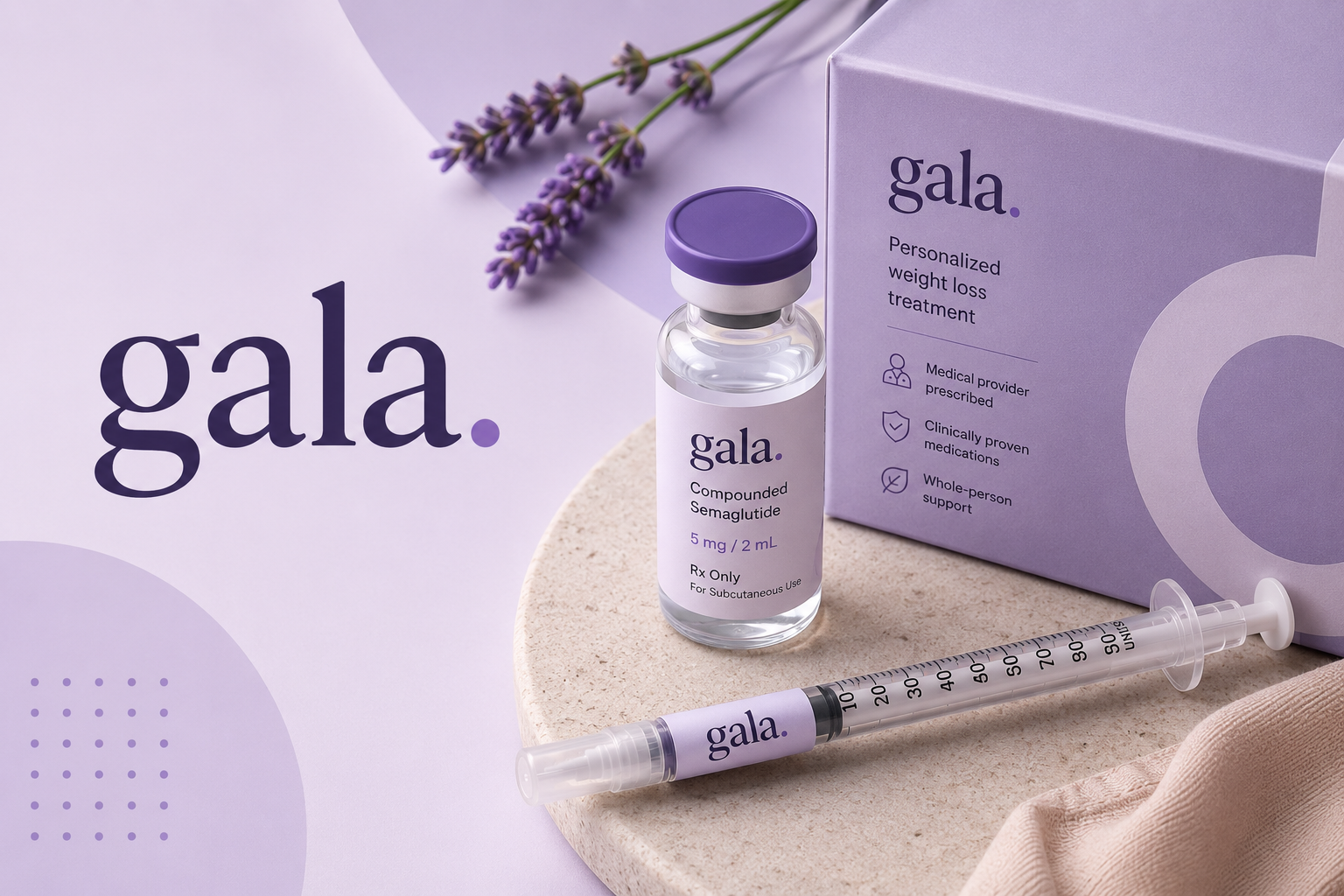
Gala’s weight-loss program is easy to understand at first glance: complete an online assessment, have a licensed clinician review your case and, if eligible, receive GLP-1 medication at home. The pricing looks similarly straightforward—$179 per month for standard compounded treatment, with higher doses included.
The details require more attention. That $179 figure is tied to a yearly subscription, while Gala’s FAQ lists $199 per month for a three-month compounded plan. The company does not publicly identify its individual dispensing pharmacies, and its principal products are compounded semaglutide and tirzepatide rather than FDA-approved Wegovy or Zepbound.
Our Gala review found a convenient telehealth model with nationwide access, dose-independent pricing and continuing provider support. Its main tradeoffs are plan commitment, limited pharmacy transparency and the regulatory uncertainty surrounding routine GLP-1 compounding.
Key takeaways
- Gala currently advertises compounded semaglutide and tirzepatide from $179 per month on a yearly plan, while a three-month plan is described elsewhere at $199 per month.
- A lower-dose or “microdosing” GLP-1/GIP pathway is advertised from $149 per month.
- Gala also lists brand-name Ozempic at $1,299 per month and has a Wegovy oral product on a waitlist.
- Licensed clinicians provide care through independent medical practices, including OpenLoop-affiliated groups, and Gala says treatment is available in all 50 states.
- Gala does not require insurance and includes provider access, medication where appropriate and online support within its subscription model.
- Cancellation requires at least 72 hours’ notice before the billing date, and cancellations generally do not qualify for refunds unless the provider medically disqualifies the patient.
Gala at a glance
| Category | What we found |
|---|---|
| Care model | Online intake, independent clinician review and home delivery |
| Main treatments | Compounded semaglutide and tirzepatide |
| Standard advertised rate | $179/month on a yearly plan |
| Three-month rate | $199/month |
| Microdosing | From $149/month |
| Brand-name option | Ozempic listed at $1,299/month |
| Insurance | Not required |
| Dose increases | No additional charge advertised |
| State availability | All 50 states |
| Pharmacy disclosure | Licensed partner pharmacies referenced but not individually named |
| Cancellation | 72 hours before billing |
| Main limitation | Compounded products plus limited pharmacy-specific transparency |
Information checked August 20, 2026. Prices, formulations, pharmacies and program terms may change.
How does Gala work?
Patients begin with a brief online assessment covering medical history, current medication, weight and treatment goals. A state-licensed healthcare professional reviews the information and decides whether prescription treatment is appropriate. A prescription is never guaranteed.
The consultation may be asynchronous through forms and messaging or synchronous by video, depending on the patient, state law and medication. Gala says that when video is required, it is typically associated with the initial evaluation; follow-up can often occur through messaging.
If approved, a third-party pharmacy fills the prescription and ships the medication. Gala itself provides administrative, technology and management services rather than practicing medicine or operating the pharmacy.
Patients can message a licensed provider during treatment, and dosage can be adjusted without an additional medication charge under Gala’s current compounded plan.
Which medications does Gala offer?
Gala’s principal weight-loss products are compounded semaglutide and compounded tirzepatide, including standard-dose and lower-dose programs. It also currently lists brand-name Ozempic and a forthcoming oral Wegovy pathway.
The compounded products are not FDA approved. They are prepared by compounding pharmacies for individual prescriptions and do not undergo FDA premarket review for finished-product safety, effectiveness or quality.
This distinction matters because clinical trial results from Wegovy or Zepbound cannot automatically be attributed to Gala’s specific compounded formulation. Gala itself acknowledges that compounded products are not reviewed or approved by the FDA.
How much does Gala cost?
The most important pricing detail is the commitment behind the advertised rate.
| Treatment | Current advertised pricing |
| Standard compounded GLP-1/GIP | $179/month on yearly subscription |
| Compounded GLP-1, three-month plan | $199/month |
| Microdosing GLP-1/GIP | $149/month |
| Ozempic | $1,299/month |
| Oral Wegovy | Coming soon; price not published |
Gala’s standard $179 rate therefore should not be compared directly with another provider’s flexible month-to-month price. Consumers should confirm whether the yearly option is billed monthly or requires a larger commitment upfront.
The subscription may include clinician consultations, medication, laboratory services, care support and 24/7 patient support, but Gala’s refund policy explicitly says the combination of covered services, labs and medications can vary.
Gala says higher prescribed doses are included without an added charge. That can be valuable compared with programs that become more expensive during titration.
Insurance, laboratory testing and clinical support
Gala does not require insurance and positions its compounded program primarily as direct-pay treatment.
Laboratory testing is less clear. Gala’s subscription policy says lab services may be included, rather than promising routine testing for every member. Requirements can reasonably vary with medication and health history, so patients should ask whether labs are required, what they cost and who reviews the results.
Gala advertises 24/7 patient support and asynchronous provider messaging. Its legal terms separately emphasize that the platform is not intended for emergencies or urgent medical situations.
Pharmacy transparency is a limitation
Gala says it works with licensed compounding pharmacies across the country but does not currently identify its pharmacy partners by name on the main public website.
That is weaker transparency than providers that publish the legal name and location of their compounding pharmacies. Before treatment, patients should ask which pharmacy will dispense their prescription and verify that pharmacy through the relevant state board of pharmacy.
The question has become more important as federal compounding rules have tightened. Semaglutide and tirzepatide are no longer on the FDA shortage list, and the agency reminds 503A pharmacies that they generally cannot regularly compound products that are essentially copies of commercially available drugs unless applicable patient-specific conditions are met.
This does not mean every Gala prescription is improper. It does mean patients should understand why a compounded formulation has been selected rather than assuming that it is simply a cheaper generic Wegovy or Zepbound.
Potential benefits
Gala may appeal because it offers:
- Flat-dose pricing on standard compounded treatment
- No insurance requirement
- Nationwide clinician access
- Both semaglutide and tirzepatide pathways
- Online prescribing and home delivery
- Provider messaging and ongoing dose adjustments
- A lower-dose program for patients whose clinician considers that approach appropriate
- A full refund when the provider medically disqualifies an applicant
Meaningful limitations
The main tradeoffs are:
- Compounded medications are not FDA approved
- The $179 headline rate requires a yearly plan
- Public pricing differs by plan and landing page
- Individual pharmacies are not publicly identified
- Laboratory coverage is not clearly standardized
- Gala does not offer meaningful insurance-navigation services
- Refund rights are restrictive once treatment begins
- Federal compounding policy may affect future availability
- Some marketing extrapolates results from studies of approved molecules to compounded treatment, which should not be interpreted as evidence for Gala’s finished products.
Cancellation and refunds
Gala allows members to cancel at any time, but the request must arrive at least 72 hours before the next billing date. Missing that deadline means another subscription charge may be processed before cancellation becomes effective.
Outside medical disqualification, Gala’s policy says cancellation does not ordinarily generate a refund. Prescription medication also cannot generally be returned once ordered for a patient. Damaged or incorrect products may be replaced by the pharmacy.
This makes it particularly important to understand how a yearly subscription is billed before committing.
Safety and eligibility considerations
Approved semaglutide and tirzepatide products commonly cause gastrointestinal side effects including nausea, vomiting, diarrhea and constipation. More serious label warnings include pancreatitis, gallbladder problems, kidney injury associated with dehydration and serious hypersensitivity reactions.
The FDA has also documented dosing errors with compounded semaglutide, partly because concentrations and syringe instructions can differ between pharmacies. Some errors have required medical attention or hospitalization.
As of May 31, 2026, the FDA had received 990 adverse-event reports involving compounded semaglutide and more than 730 involving compounded tirzepatide. Reports do not prove that the medication caused every event, but they reinforce the need for careful prescribing, dosing instructions and follow-up.
Patients should know the exact medication, concentration and dose they are prescribed and seek prompt medical care for severe or persistent symptoms rather than relying on routine portal messaging.
Who may find Gala worth considering?
Gala may be worth considering for adults who expect to pay cash, are comfortable discussing compounded treatment and value flat pricing as their dose increases.
Its women-focused positioning may also appeal to patients who want weight management integrated with broader midlife or hormone-related care.
Gala may not suit people who want only FDA-approved medication, require insurance authorization, prefer a publicly named pharmacy before checkout or want a highly flexible refund policy.
Questions to ask before enrolling
- What exact drug and formulation am I receiving?
- Why is compounded treatment appropriate for my individual needs?
- Which pharmacy will prepare the prescription?
- Is my plan three months or one year?
- How much will be charged today?
- Are laboratory tests required or included?
- Does my price stay the same at every dose?
- Who responds to clinical messages outside normal business hours?
- When must I cancel to prevent another charge?
- What happens if compounded GLP-1 availability changes?
Final assessment
Gala offers a convenient nationwide program with relatively competitive compounded-GLP-1 pricing, included provider support and no dose-related price increase. Those are meaningful advantages for some cash-pay patients.
The tradeoffs are equally important. The lowest standard rate is linked to a long-term plan, compounded products are not FDA approved, pharmacy partners are not publicly identified and the refund policy leaves little flexibility after treatment begins.
Gala may be worth considering after a licensed clinician determines that treatment is appropriate and the patient receives clear written information about the pharmacy, formulation, billing commitment and cancellation date.
Frequently asked questions
Is Gala Health legitimate?
Gala is operated by AI Coaching Inc. and functions as a telehealth administrative platform connecting patients with independent licensed providers and partner pharmacies. Its terms explicitly state that Gala itself does not practice medicine or operate a pharmacy.
How much does Gala cost?
Standard compounded treatment is advertised from $179 per month on a yearly subscription. Gala’s FAQ lists $199 per month for a three-month plan, while microdosing starts at $149.
Does Gala include medication in the price?
The subscription includes medication where medically appropriate plus provider access and online support. Exact included services and laboratory testing can vary by plan.
Does Gala accept insurance?
Insurance is not required for the primary program. Gala’s current public materials emphasize direct-pay treatment rather than insurance billing or prior-authorization support.
Are Gala’s compounded medications FDA approved?
No. Gala clearly states that compounded GLP-1 products are not FDA approved.
Can I cancel Gala?
Yes, but Gala requires cancellation at least 72 hours before the billing date. Cancellation generally does not result in a refund unless the provider medically disqualifies the patient.