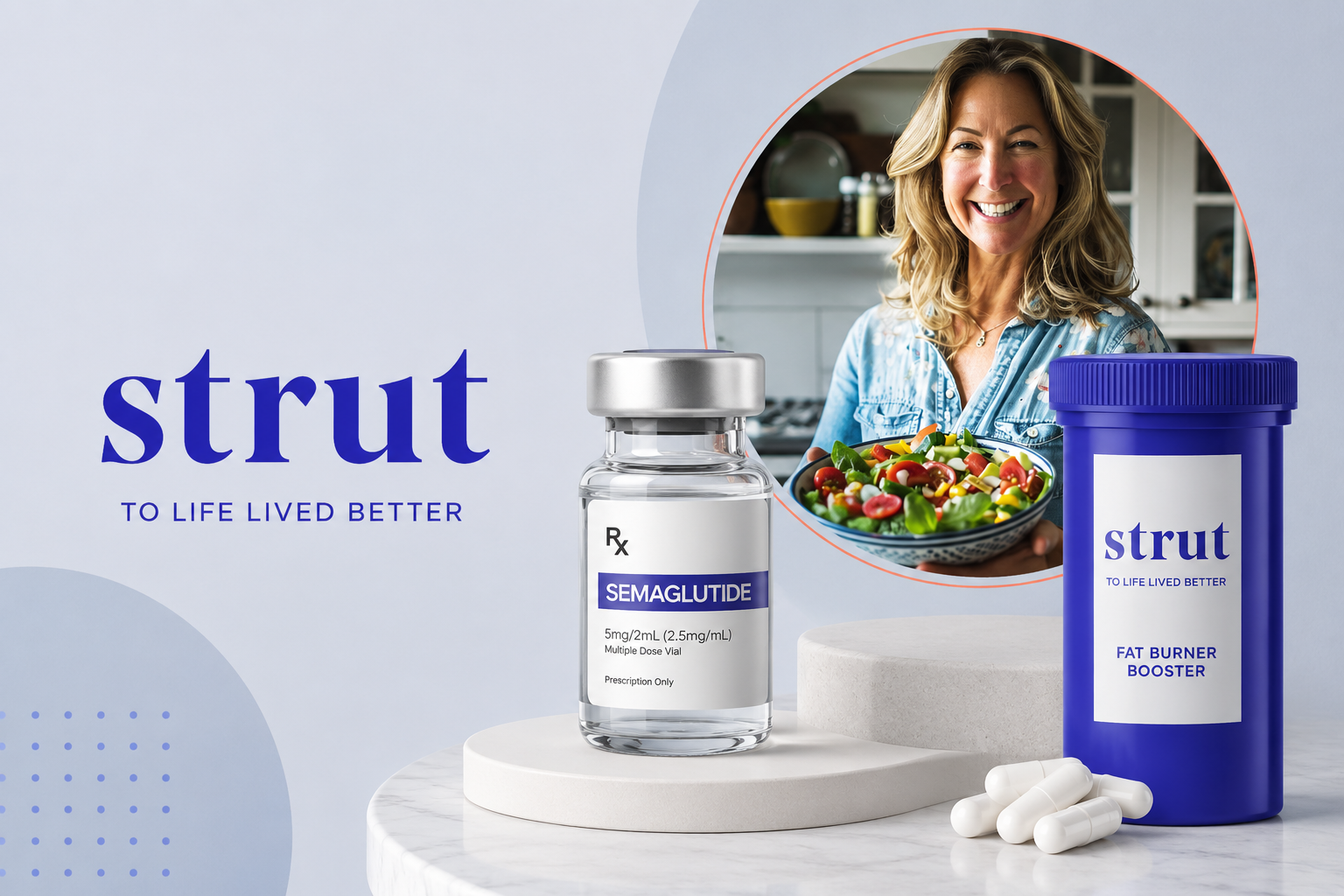
Strut’s weight-loss program is inexpensive compared with many online GLP-1 subscriptions. Compounded semaglutide is advertised from $99 per month for a daily lozenge or $149 for a weekly injection, with physician consultations and shipping included. Compounded tirzepatide starts higher.
Price alone does not tell the full story. Strut mainly offers compounded medications rather than FDA-approved Wegovy or Zepbound, does not publicly identify the pharmacy filling a particular prescription and received an FDA warning letter in February 2026 over misleading claims and product labeling involving compounded semaglutide and tirzepatide.
Our Strut review found a convenient cash-pay model with included clinician access and unusually low entry pricing. Consumers should nevertheless verify the exact product, dispensing pharmacy and recurring charge before paying.
Key takeaways
- Strut currently offers compounded semaglutide and tirzepatide as both injectable and sublingual treatments. The finished compounded products are not FDA approved.
- Compounded semaglutide is advertised at $99 per month for oral lozenges and $149 for injections. Tirzepatide pages advertise auto-refill pricing from $199, although the same pages also display higher 30-day prices.
- Medication pricing includes the initial physician consultation, follow-ups and shipping; there is no separate weight-loss membership fee prominently advertised.
- Strut does not accept insurance or complete prior-authorization paperwork. HSA/FSA cards may work, but the card issuer can reject the charge.
- Medical services are provided through Titan Health, P.A. and affiliated entities. Strut itself provides the nonclinical technology and administrative platform.
- The FDA warned Strut in February 2026 that earlier website claims misleadingly suggested Strut was the compounder and implied its compounded products were comparable to FDA-approved drugs.
Strut Health at a glance
| Category | What we found |
|---|---|
| Care model | Online assessment, physician review, pharmacy fulfillment and recurring refills |
| Main weight-loss drugs | Compounded semaglutide and tirzepatide |
| Semaglutide pricing | $99 oral; $149 injectable |
| Tirzepatide pricing | Auto-refill advertised from $199; higher 30-day prices also displayed |
| Separate membership | None prominently advertised |
| Physician visits | Included |
| Shipping | Included |
| Insurance | Not accepted |
| Clinical entity | Titan Health, P.A. and affiliates |
| Published state access | FAQ says all states except Arkansas; confirmation recommended |
| Pharmacy transparency | Network referenced, specific compounder not prominently named |
| Main concern | February 2026 FDA warning letter |
Information reviewed August 20, 2026. Prices, pharmacy coverage, formulations and legal requirements can change.
How does Strut Health work?
Patients begin by creating an account and completing an online medical questionnaire. Strut says a U.S.-licensed physician reviews the information and determines whether treatment is appropriate. Its legal terms explicitly state that submitting information does not guarantee that a prescription will be written.
Medical services are provided through Titan Health rather than Strut Health itself. The platform supports both synchronous and asynchronous telehealth, meaning some evaluations may occur through online forms and messaging rather than a conventional video appointment.
If treatment is approved, the prescription is sent to a pharmacy. Strut’s current support center says injectable orders ship within seven days of approval using FedEx two-day delivery; other compounded medications typically leave the pharmacy within 24 hours after approval.
Members can message their provider and receive follow-up consultations without an additional visit charge. Prescriptions operate as subscriptions, with Strut’s terms describing recurring billing every 30 or 90 days depending on the refill schedule.
Which GLP-1 medications does Strut offer?
Strut currently lists four principal GLP-1 options:
- Compounded injectable semaglutide with vitamin B6
- Compounded sublingual semaglutide lozenges
- Compounded injectable tirzepatide with vitamin B6
- Compounded sublingual tirzepatide lozenges
These products require what Strut now describes as medical necessity. Its current semaglutide page states that a compounded product is intended for a patient whose clinical needs cannot be met by an FDA-approved option. Its tirzepatide page similarly says compounded treatment is available only when commercially available GLP-1 medication cannot be used.
That language is significant because federal policy has tightened since national semaglutide and tirzepatide shortages ended. The FDA reminds 503A compounders that they generally cannot regularly produce products that are essentially copies of commercially available medications.
Strut’s oral products deserve separate consideration
Strut’s $99 semaglutide product is a compounded sublingual lozenge. It should not be confused with the FDA-approved Wegovy oral tablet. The dosage form, formulation and route of administration differ, so clinical evidence for an approved tablet cannot simply be transferred to Strut’s compounded lozenge.
The same issue is even more pronounced with Strut’s tirzepatide lozenge. FDA-approved Zepbound is an injectable tirzepatide product; Strut’s daily sublingual tirzepatide is a separately compounded formulation and has not undergone the FDA approval process.
How much does Strut cost?
Strut’s current public pricing is:
| Treatment | Advertised pricing |
| Compounded oral semaglutide | $99/month |
| Compounded injectable semaglutide | $149/month |
| Compounded oral tirzepatide | Auto-refill from $199; page also lists $239/30 days |
| Compounded injectable tirzepatide | Auto-refill from $199; page also lists $325/30 days |
The semaglutide pricing is relatively clear. Tirzepatide is not.
For example, the injectable page simultaneously promotes auto-refill pricing “as low as $199” and lists a 30-day supply at $325. The oral page advertises auto-refill from $199 while showing $239 for a 30-day supply. These differences may reflect subscription discounts, formulation or dosing, but the public presentation does not fully explain the relationship between the figures.
The most useful comparison number is therefore the final recurring charge shown after the clinician and pharmacy determine the prescription, not simply the lowest figure on the product page.
Strut states that physician consultations and shipping are included in the medication price.
Insurance, laboratory testing and state availability
Strut is a cash-pay service. Its FAQ says it does not accept insurance, while its terms clarify that neither Strut nor Titan Health is an insurer. Strut also says it does not complete prior-authorizations or letters of medical necessity for insurance reimbursement.
The platform accepts major credit cards. HSA or FSA cards can be attempted but may be declined by the issuing plan.
We did not identify routine laboratory testing as a standard included component of Strut’s GLP-1 programs. Its terms contain a separate laboratory-services section, but that does not establish that bloodwork is required or included for weight-loss treatment. Whether labs are appropriate therefore appears to depend on the clinician and patient.
State coverage also deserves confirmation. Strut’s current FAQ still states that it ships to every state except Arkansas, but that statement is identified as current “as of September 2024.” Its legal terms more cautiously say services may not be available in every state.
Pharmacy transparency is Strut’s biggest trust issue
Strut says it works with U.S.-licensed compounding pharmacies and allows patients to request that an ordinary prescription be sent to a pharmacy of their choice. However, the company does not prominently identify the partner pharmacy that will compound its GLP-1 products on the public treatment pages we reviewed.
That omission matters because the FDA specifically advises patients using compounded GLP-1 products to know where their medication came from and to verify that it was filled by a state-licensed pharmacy.
It is also directly relevant to Strut’s recent regulatory history.
What did the FDA warning letter say?
On February 20, 2026, the FDA issued a warning letter to Strut Health after reviewing its website in December 2025.
The agency raised two central concerns. First, product images displayed the Strut name in a way the FDA said falsely or misleadingly suggested Strut itself had compounded the products. Second, the site used claims including “Generic Zepbound, Mounjaro” and other descriptions that the agency said implied the compounded drugs had been FDA approved or evaluated for safety and effectiveness when they had not.
The letter instructed Strut to address the violations and specifically suggested identifying the entities producing its compounded products and correcting other potentially misleading claims.
Current pages have clearly changed. Strut now repeatedly states that its compounded products are not FDA approved and that medical necessity is required.
That is an important improvement. However, we did not identify a subsequent FDA close-out letter in the agency’s current public search results. The warning should therefore remain part of a balanced assessment rather than being treated as irrelevant history.
Potential benefits
Strut may appeal because it offers:
- Some of the lower advertised compounded GLP-1 prices
- No separate membership charge
- Physician consultation included
- Free delivery
- Ongoing physician messaging and follow-ups
- Both injectable and needle-free compounded formats
- Freedom to send eligible prescriptions to another pharmacy
- Flexible subscription cancellation rather than a mandatory annual commitment
Meaningful limitations
The principal tradeoffs are:
- The main weight-loss products are compounded rather than FDA approved
- Partner compounding pharmacies are not prominently named
- Tirzepatide pricing is confusing
- Insurance and prior-authorization assistance are not offered
- No structured dietitian or behavioral-coaching program is prominently included
- The oral compounded formulations should not be assumed equivalent to approved products
- Strut received an FDA warning letter in February 2026
- GLP-1 compounding is subject to tighter federal restrictions now that shortages have resolved
Cancellation and refunds
Strut describes its prescriptions as subscriptions that renew every 30 or 90 days depending on the treatment. Patients can pause or cancel by contacting the company.
Strut asks for at least 48 hours’ notice before the next refill or shipment. Once the pharmacy has processed or dispatched the prescription, refunds generally cannot be issued.
New orders are also time-sensitive. Strut says it will try to cancel an initial order before physician review and approval, but once the order has been medically approved it cannot ordinarily be cancelled.
That makes the checkout decision more consequential than “cancel anytime” language might suggest.
Safety and eligibility considerations
FDA-approved semaglutide and tirzepatide products commonly cause gastrointestinal effects such as nausea, vomiting, diarrhea and constipation. Their prescribing information also warns about pancreatitis, gallbladder disease, kidney injury related to dehydration, severe gastrointestinal reactions and serious hypersensitivity.
Major contraindications and precautions also need individualized review rather than relying on an online eligibility quiz alone.
Compounded injections introduce additional considerations. The FDA has received reports of serious adverse events related to dosing errors, including situations in which patients measured the wrong quantity from multidose vials. The agency advises patients and clinicians to confirm the concentration, dose and syringe measurement carefully.
As of May 31, 2026, FDA had received 990 adverse-event reports associated with compounded semaglutide and more than 730 involving compounded tirzepatide. The agency cautions that these reports do not establish that the medication caused every event, and adverse events from state-licensed pharmacies may also be underreported.
Who may find Strut worth considering?
Strut may appeal to adults who expect to pay cash, prefer a low-cost telehealth subscription and are comfortable discussing compounded treatment when a clinician determines there is a patient-specific need.
Its sublingual options may also interest people who strongly prefer to avoid injections, provided they understand that those compounded formulations are different from FDA-approved oral or injectable products.
Strut may not suit people who want only FDA-approved medication, require insurance authorization, prefer a publicly identified dispensing pharmacy before enrollment or want integrated dietitian and behavioral support.
Questions to ask before enrolling
- What exact formulation and concentration will I receive?
- Why is a compounded product medically necessary for me?
- Which pharmacy will compound and dispense it?
- Is my quoted price an auto-refill discount or the standard rate?
- What will the next refill actually cost?
- Are any laboratory tests required?
- How frequently will a physician reassess my treatment?
- How should I measure my injection dose?
- When does my current order become nonrefundable?
- What treatment options are available if compounded GLP-1 access changes?
Final assessment
Strut’s biggest advantage is accessibility. Its $99 oral and $149 injectable semaglutide prices include physician care and shipping, and patients are not required to buy an expensive annual membership to reach the lowest advertised rate.
The tradeoff is transparency. Tirzepatide prices are presented inconsistently, the dispensing pharmacy is not prominently identified and the company received a significant FDA warning letter only six months ago.
Current Strut pages show meaningful improvements in disclosure: they explicitly state that compounded medications are not FDA approved and say prescriptions require a documented medical need. That makes the program easier to evaluate than its earlier marketing.
Strut may be worth considering for a carefully screened cash-pay patient, but only after confirming the specific pharmacy, formulation, medical rationale and recurring price in writing.
Frequently asked questions
Is Strut Health legitimate?
Strut Health is an identifiable U.S. telehealth company with published legal terms, contact information and a named clinical relationship with Titan Health, P.A. Prescribing decisions are made by licensed providers. However, the FDA issued Strut a warning letter in February 2026 concerning misleading promotion of its compounded GLP-1 products.
How much does Strut weight-loss treatment cost?
Current semaglutide pricing is $99 per month for a compounded sublingual lozenge and $149 for a compounded injection. Tirzepatide pages advertise auto-refill prices from $199 but also show 30-day prices of $239 orally and $325 by injection, so the final checkout price needs verification.
Does Strut accept insurance?
No. Strut is a cash-pay telemedicine service and does not process insurance claims or prior authorizations. HSA/FSA cards may be accepted depending on the account provider.
Are Strut’s GLP-1 medications FDA approved?
Its principal semaglutide and tirzepatide products are compounded and are not FDA approved. Strut’s current treatment pages now state this directly.
Which pharmacy does Strut use?
Strut says it uses a network of U.S.-licensed compounding pharmacies but does not prominently identify the GLP-1 compounder on the public product pages we reviewed. Patients should request the pharmacy’s legal name and verify its license before treatment.
Does Strut require bloodwork?
We found no universal laboratory requirement for Strut’s weight-loss program. A clinician may determine that testing is appropriate based on the individual’s history or proposed treatment.
Can I cancel Strut at any time?
Future refills can be cancelled or paused, but Strut requests at least 48 hours’ notice. Once a pharmacy has processed the order, a refund generally cannot be guaranteed.