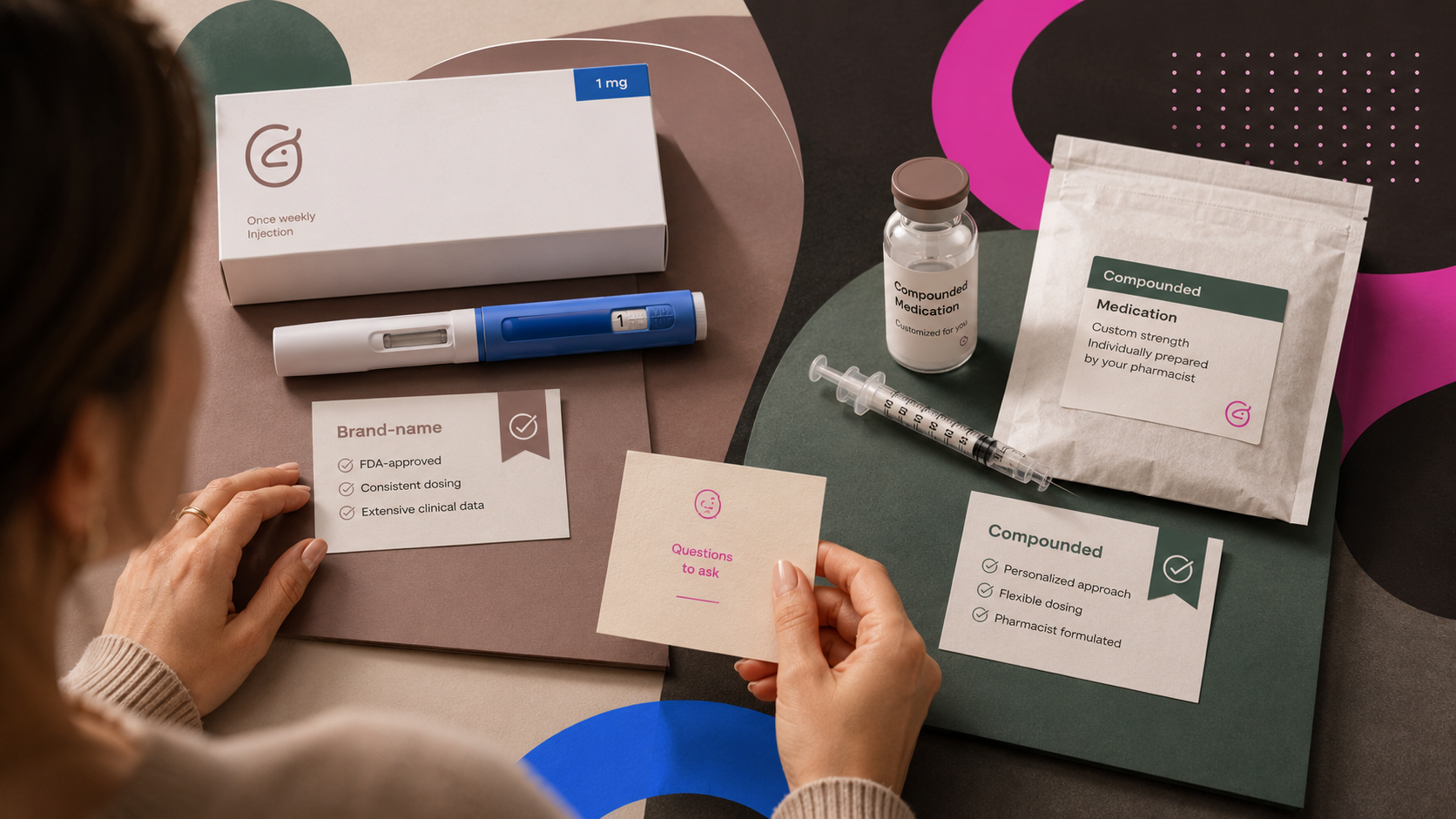
Two online weight-loss programs may appear to offer the same medication while quoting very different prices. One may advertise Wegovy or Zepbound. Another may offer “semaglutide” or “tirzepatide” prepared by a compounding pharmacy for a fraction of the apparent cost.
The names can make these options sound interchangeable. They are not.
An FDA-approved brand-name medication and a compounded preparation containing an ingredient with the same name follow different regulatory pathways. They may differ in formulation, concentration, packaging, dosing instructions, pharmacy oversight and supporting evidence. A compounded product is also not an FDA-approved generic.
That distinction does not mean that every compounded prescription is inappropriate. Compounding has a legitimate role when an individual patient’s medical needs cannot be met by an available FDA-approved medication. But it does mean that consumers should understand exactly what they are being prescribed, who is preparing it and why that option is being recommended.
CliniqGuide does not provide medical care or determine which medication is appropriate for an individual. A prescription requires evaluation by a licensed healthcare professional.
Key takeaways
- FDA approval applies to a specific drug product—not merely an ingredient name. It covers the formulation, strength, dosage form, manufacturing process, labeling and uses evaluated in the approval application.
- Compounded GLP-1 medications are not FDA approved. FDA does not review each compounded product for safety, effectiveness or quality before it is marketed.
- Compounded products are not generics and should not be described as equivalent substitutes for Wegovy, Ozempic, Zepbound or Mounjaro. FDA-approved generics must meet approval requirements that compounded drugs do not.
- The end of the national semaglutide and tirzepatide shortages narrowed the shortage-based pathway for producing copies of approved products. The legality of a particular compounded prescription now depends on the circumstances, the compounder and applicable federal and state requirements.
- Price should not be considered in isolation. Patients should also compare the pharmacy, formulation, dose instructions, supplies, shipping, clinician access, monitoring and cancellation terms.
Brand-name and compounded GLP-1 medications explained
A brand-name drug such as Wegovy or Zepbound is an FDA-approved commercial product. The manufacturer submitted evidence and manufacturing information for FDA review, and the approved product must be produced and labeled according to that authorization.
Wegovy contains semaglutide and has FDA-approved indications that include long-term weight reduction for certain adults and adolescents, as well as other specified indications. Zepbound contains tirzepatide and is approved for long-term weight reduction in eligible adults and for moderate-to-severe obstructive sleep apnea in adults with obesity. Each product has its own approved presentations, dosage schedule, contraindications, warnings and instructions.
A compounded medication is prepared by a licensed pharmacist, licensed physician or qualifying outsourcing facility under a separate part of federal and state law. A pharmacy might alter a dosage form, remove an ingredient to which a patient is allergic or create a strength that is not commercially available when the prescriber determines that the change is clinically significant for that patient.
The compounded preparation does not become FDA approved simply because its active ingredient has also been used in an approved medication.
Brand-name versus compounded GLP-1 medication
| Comparison point | FDA-approved brand-name medication | Compounded medication |
| Regulatory status | Reviewed and approved by FDA as a specific drug product | Not FDA approved |
| Premarket evidence | FDA reviews evidence supporting the product’s safety and effectiveness for its approved uses | The individual compounded product does not undergo FDA premarket review |
| Product standardization | Manufactured to the approved formulation, strength and specifications | Formulation, strength, excipients and concentration may vary by prescription and pharmacy |
| Generic equivalence | Not applicable unless an FDA-approved generic is available | Not a generic and not automatically therapeutically equivalent |
| Packaging | May use approved pens, vials, tablets or other presentations | Often supplied in pharmacy-labeled vials or another compounded dosage form |
| Dose instructions | Based on the product’s FDA-approved labeling and clinician judgment | Based on the prescription, concentration and instructions supplied by the prescriber and pharmacy |
| Primary oversight | FDA regulates the approved product and manufacturer | Oversight depends on whether the compounder operates under section 503A or 503B, as well as state law |
| Insurance | Coverage varies by plan, indication and prior-authorization rules | Frequently offered as cash-pay treatment; reimbursement varies |
| Appropriate use | When clinically indicated and available | May be considered when a patient has a medical need that cannot be met by an approved product, subject to legal requirements |
The practical message is not that two products with the same named ingredient have nothing in common. It is that the ingredient name alone does not establish sameness in formulation, dose delivery, quality controls or clinical evidence.
What FDA approval establishes
FDA approval is often reduced to a marketing badge, but its meaning is more specific.
The agency reviews a defined product submitted by a manufacturer. That review addresses evidence of effectiveness for the proposed indication, known risks, manufacturing information, labeling, stability and quality controls. Once approved, the manufacturer must continue to comply with applicable manufacturing, reporting and postmarketing requirements.
FDA approval does not mean that a medication is free from risk or appropriate for every patient. Wegovy and Zepbound, for example, carry boxed warnings concerning thyroid C-cell tumors observed in rodents and are contraindicated in people with a personal or family history of medullary thyroid carcinoma or multiple endocrine neoplasia syndrome type 2. Their labels also describe gastrointestinal reactions and other potentially serious risks.
Approval means that the FDA evaluated the specific product and determined that its benefits outweigh its known risks when used according to the approved labeling—not that adverse effects cannot occur.
Compounding can fill a legitimate patient need
Compounding is not inherently illegitimate. It has long been used when an approved medication cannot appropriately meet an individual patient’s needs.
The FDA gives examples such as removing a dye for a patient with an allergy or preparing a liquid for someone unable to swallow a commercially available tablet. In these circumstances, a prescriber may determine that a particular change would produce a significant difference for an identified patient.
However, federal restrictions generally prevent compounding from functioning as an unrestricted alternative manufacturing pathway for routine copies of commercially available drugs. FDA guidance states that a lower price alone is not sufficient to establish the patient-specific significant difference used in the section 503A framework.
This is a crucial distinction for GLP-1 shoppers. Affordability may be the reason a patient searches for compounded treatment, but affordability by itself does not establish the legal or medical basis for compounding a copy of an available approved product.
Compounded medication is not an FDA-approved generic
The word “generic” has a defined regulatory meaning. An FDA-approved generic must satisfy approval requirements, including demonstrating pharmaceutical equivalence and, where applicable, bioequivalence to its reference product.
A compounded medication does not go through that abbreviated drug approval process. FDA explicitly distinguishes compounded drugs from approved generics.
For that reason, phrases such as “generic Wegovy,” “generic Ozempic” or “generic Zepbound” should not be used to describe a compounded preparation unless the product is genuinely an FDA-approved generic.
The distinction also applies to provider-created names. A telehealth company’s branding does not turn a compounded drug into a proprietary FDA-approved product or establish that the telehealth platform itself compounded the medication. In March 2026, FDA announced warning letters to 30 telehealth companies over allegedly false or misleading compounded-GLP-1 marketing, including claims that implied sameness with approved products or obscured the identity of the actual compounder.
Why the end of the GLP-1 shortages matters
Demand for semaglutide and tirzepatide contributed to national drug shortages beginning in 2022. When an approved drug appears on the FDA’s shortage list, compounders may under certain conditions prepare versions that would otherwise encounter restrictions as copies of available approved products.
The FDA determined that the tirzepatide injection shortage was resolved in December 2024 after reevaluation. It determined that the semaglutide injection shortage was resolved in February 2025. Transitional enforcement periods later ended for section 503A and 503B compounders.
As of the FDA’s April 2026 update, semaglutide and tirzepatide did not appear on the drug-shortage list or the section 503B bulks list. In a separate April 2026 action, FDA proposed excluding semaglutide, tirzepatide and liraglutide from the 503B bulks list after stating that it had not identified a clinical need for outsourcing facilities to compound those drugs from bulk substances. That proposal was subject to public comment and should be checked again before publication for a final decision.
The end of the shortages did not make all compounding illegal. It did, however, remove the broad shortage-based rationale for routinely producing essentially identical copies. The legal analysis for any current compounded product is fact-specific and may depend on the patient’s prescription, the formulation change, the facility type and applicable state requirements.
503A pharmacy versus 503B outsourcing facility
Consumers may see the terms 503A and 503B in provider or pharmacy materials. They describe different compounding frameworks.
Section 503A pharmacies
Section 503A generally applies to compounding by a licensed pharmacist in a state-licensed pharmacy or federal facility, or by a licensed physician. These prescriptions are generally tied to an identified individual patient. State boards of pharmacy have primary day-to-day oversight, although FDA can conduct surveillance or for-cause inspections. Qualifying section 503A compounders are not subject to the same current good manufacturing practice requirements as conventional drug manufacturers or section 503B outsourcing facilities.
Section 503B outsourcing facilities
A section 503B outsourcing facility elects to register with the FDA, compounds sterile drugs and must meet additional federal requirements, including current good manufacturing practice requirements. FDA inspects outsourcing facilities on a risk-based schedule, and registered facilities report compounded products to the agency.
Registration should not be mistaken for approval. The FDA states that registering as an outsourcing facility does not mean the agency has approved its products or determined that the facility is currently compliant with every applicable requirement.
Patients should ask which facility actually prepared their medication rather than accepting “made at an FDA-registered facility” as a complete quality statement.
Formulation, concentration and delivery can differ
FDA-approved brand-name drugs are supplied in defined presentations. Depending on the medication and current labeling, these may include single-dose pens, vials, multidose devices or tablets. Instructions are written for that specific presentation.
Compounded injectable medication may arrive in a multidose vial with separate syringes. Its concentration can vary among pharmacies or prescriptions. A patient may therefore be instructed to withdraw a volume measured in milliliters or syringe “units,” rather than use a premeasured commercial pen.
This creates an additional opportunity for error. The FDA has received reports of compounded-semaglutide overdoses caused by patients drawing up the wrong amount and by healthcare professionals miscalculating conversions among milligrams, milliliters and syringe units. Some cases required hospitalization.
Before using a vial, the patient should be able to answer all of the following:
- What is the concentration in milligrams per milliliter?
- What dose in milligrams was prescribed?
- What volume should be drawn into the syringe?
- What do the numbered markings on the supplied syringe represent?
- Does the concentration change with the next shipment?
- Who should be contacted if the label and clinician instructions do not match?
A medication labeled only in “units” without a clear explanation of the concentration and intended dose deserves clarification before administration.
The active ingredient itself also requires scrutiny
The FDA has warned that some compounded products marketed as semaglutide may contain semaglutide sodium or semaglutide acetate. These salt forms are different active ingredients from the base form used in FDA-approved semaglutide products. The FDA has stated that it lacks information establishing that the salt forms have the same chemical and pharmacologic properties and is not aware of a lawful basis for their use in compounding.
Patients considering compounded semaglutide should ask the prescriber and dispensing pharmacy whether the preparation uses semaglutide base and request an unambiguous answer.
Added ingredients also warrant discussion. Some compounded GLP-1 preparations include vitamin B12, vitamin B6, glycine or other components. The presence of another ingredient does not automatically make the formulation better, safer or clinically necessary. Ask why it has been included, whether the change is intended to meet a specific patient need and what evidence supports the combination.
How treatment through an online clinic usually works
A responsible telehealth process generally includes:
- An intake covering medical history, current medications, allergies and relevant symptoms
- Review by a clinician licensed to treat patients in the relevant state
- A video, telephone or asynchronous consultation as permitted and clinically appropriate
- An eligibility decision and discussion of treatment alternatives
- A prescription only if the clinician determines that medication is appropriate
- Fulfillment by a clearly identified pharmacy
- Instructions for storage, dosing and administration
- Follow-up for side effects, treatment response and dose changes
- A process for urgent questions, discontinuation or switching treatment
Completing a questionnaire does not guarantee that a prescription should be issued. A clinic promising approval before a clinician has reviewed the patient’s history is not demonstrating meaningful medical evaluation.
Mochi Health, for example, currently lists FDA-approved products and compounded preparations separately. Its compounded semaglutide and tirzepatide pages state that the products are non-FDA-approved formulations, are prepared by state-licensed compounding pharmacies under a prescription and are not interchangeable with FDA-approved products. That distinction is an appropriate transparency practice, although patients should still independently examine the pharmacy, formulation, care process and current terms.
How to evaluate a GLP-1 program
1. Confirm who is making the clinical decision
The program should identify the type of licensed professional reviewing the intake and explain how patients communicate with that person. Look for more than statements that a provider is “in the network.”
Ask whether the same clinician will oversee follow-up or whether each request is routed to a different person.
2. Identify the dispensing pharmacy before paying
The telehealth platform and dispensing pharmacy may be separate businesses. Ask for the pharmacy’s legal name and location.
The FDA advises consumers to verify an online pharmacy through the relevant state board of pharmacy. A safer online pharmacy requires a prescription, provides a U.S. address and telephone number and makes a licensed pharmacist available for questions.
For a 503B facility, patients can also check the FDA’s current outsourcing-facility registration list. The list is updated regularly, so verification should be repeated rather than relying on an old screenshot or marketing badge.
3. Ask exactly what product is prescribed
“Semaglutide” is not a complete product description. Clarify:
- Brand-name or compounded
- Injectable, oral or another dosage form
- Active ingredient and chemical form
- Strength and concentration
- Additional ingredients
- Pharmacy name
- Storage requirements
- Beyond-use or expiration date
- Required syringes and supplies
4. Compare the dosing system, not only the milligram number
A premeasured commercial pen and a multidose compounded vial may require very different administration steps. Patients who are uncomfortable measuring small volumes may place greater value on a fixed-dose device.
A clinic offering vials should provide clear written instructions and access to a clinician or pharmacist who can confirm the dose.
5. Examine follow-up care
Useful follow-up includes a way to report side effects, review progress, discuss dose escalation and obtain help when a shipment is delayed or arrives at the wrong temperature.
The FDA has received complaints about compounded injectable GLP-1 products arriving warm or without adequate cold packaging. The agency advises patients not to use an injectable GLP-1 product that arrives warm or inadequately refrigerated because product quality may be affected.
Cost: compare the complete treatment pathway
Compounded medication is often marketed primarily on price, but the advertised drug cost may not represent the full monthly expense.
Potential charges include:
- Membership or platform fee
- Medication
- Initial consultation
- Laboratory testing
- Follow-up appointments
- Syringes, needles and alcohol swabs
- Shipping or temperature-controlled packaging
- Prior-authorization assistance
- Replacement shipments
- Cancellation fees or prepaid commitments
Brand-name treatment may involve a pharmacy copay, deductible, coinsurance or cash price. Manufacturer self-pay and savings programs can substantially change the comparison, but eligibility rules, dose-specific pricing and expiration dates apply.
As of July 29, 2026, Novo Nordisk advertised a two-fill introductory self-pay offer of $199 per month for certain starting doses of Wegovy injection, followed by published standard self-pay pricing of $349 per month for several doses. Eli Lilly’s published Zepbound savings terms listed different potential prices based on the delivery device, dose and insurance circumstances, including self-pay or savings-card amounts beginning below the price of a conventional single-dose pen. These programs can be modified or ended by the manufacturer.
Mochi Health currently advertises compounded semaglutide beginning at $99 per month and compounded tirzepatide beginning at $199 per month, plus a separate membership. Its weight-loss page lists a $39 new-member first month followed by $79 monthly and states that medication and diagnostic services are not included in the membership. Its FAQ says shipping is included in the medication price. These are provider-reported terms and should be rechecked immediately before publication or enrollment.
Illustrative cost comparison
| Cost component | Brand-name pathway | Compounded telehealth pathway |
| Medication | Insurance copay, deductible, manufacturer offer or cash price | Commonly advertised as a cash-pay monthly medication charge |
| Program membership | May or may not apply | Frequently charged separately |
| Insurance | May cover medication with eligibility and prior authorization | Often not billed for the compounded medication; verify reimbursement |
| Dose pricing | May depend on presentation, program and current offer | May be flat across doses or rise with dose, depending on provider |
| Supplies | Usually integrated into a commercial pen; vials may require supplies | Syringes and supplies may be included or separate |
| Shipping | Retail pickup or pharmacy delivery | May be included, separate or subject to replacement policies |
| Main pricing risk | Assuming the lowest promotional or insured price applies indefinitely | Assuming the medication price includes membership, labs and follow-up |
The fairest comparison is the expected cost over at least three to six months—not the first-month headline.
Benefits and limitations
FDA-approved brand-name medication may appeal to patients who value:
- A product reviewed by the FDA for its approved use
- Standardized formulation, labeling and manufacturing specifications
- Commercial delivery devices with defined instructions
- An evidence base tied to the exact approved product
- The possibility of insurance coverage or manufacturer support
Potential limitations include high out-of-pocket costs, prior-authorization requirements, plan exclusions and occasional local supply disruptions.
Compounded medication may be worth discussing when:
- A clinician identifies a genuine patient-specific need that an available approved product cannot meet
- A required dosage form or excipient change is medically significant
- Compounding is carried out through an appropriately licensed and transparent pharmacy
- The patient can confidently follow the specific dosing instructions
- The clinic provides meaningful ongoing clinical support
Potential limitations include the absence of FDA premarket review, variability among pharmacies and formulations, more complex vial dosing, limited insurance reimbursement and a changing regulatory environment.
Cost alone should not be presented as proof that a compounded preparation is clinically appropriate.
Safety and eligibility considerations
Semaglutide and tirzepatide treatment requires individualized assessment regardless of whether the medication is branded or compounded.
The FDA-approved Wegovy and Zepbound labels identify common adverse reactions that are predominantly gastrointestinal, including nausea, vomiting, diarrhea, constipation and abdominal symptoms. The labels also address serious risks such as pancreatitis, gallbladder disease, kidney injury related to dehydration, severe gastrointestinal reactions and hypersensitivity. Concomitant insulin or certain diabetes medications can increase the risk of hypoglycemia.
These medications are contraindicated in people with a personal or family history of medullary thyroid carcinoma or multiple endocrine neoplasia syndrome type 2. Pregnancy, planned pregnancy, severe gastrointestinal disease, previous reactions, diabetes treatment and other medical factors require careful discussion with a clinician. Product-specific recommendations differ, so patients should follow the applicable prescribing information and their clinician’s instructions rather than transferring instructions from one product to another.
Persistent vomiting, inability to keep fluids down, signs of a serious allergic reaction or severe and persistent abdominal pain warrant prompt medical assessment. A telehealth service should clearly explain how to obtain urgent help and should not imply that in-app messaging substitutes for emergency care.
Red flags and positive trust signals
| Red flag | More reassuring signal |
| “Same as Wegovy” or “generic Zepbound” used for a compounded drug | Clear statement that the compounded product is not FDA approved or interchangeable |
| Guaranteed prescription | Eligibility depends on clinical evaluation |
| Pharmacy not identified | Legal pharmacy name and location supplied before treatment |
| “FDA-approved compound” | Accurate explanation of the product’s regulatory status |
| Medication sold without a prescription | Prescription required from a licensed professional |
| Research-use-only powder offered for self-injection | Patient-labeled prescription medication from a licensed pharmacy |
| Dose described only as syringe units | Dose, concentration and volume explained in writing |
| No clinician available after delivery | Defined follow-up and side-effect contact process |
| Product arrives warm or damaged | Cold-chain instructions and replacement procedure |
| No cancellation details | Recurring charges, renewal and cancellation terms disclosed before payment |
The FDA has also reported fraudulent products labeled as compounded semaglutide or tirzepatide using nonexistent pharmacy names or the names of pharmacies that did not actually prepare them. Patients should compare the dispensing label with information supplied by the clinic and contact the pharmacy directly when anything appears inconsistent.
Who each pathway may suit
An FDA-approved brand-name product may be a better fit for a person who prioritizes a standardized commercial product, prefers a premeasured device, has insurance coverage or qualifies for a manufacturer program.
A compounded preparation may be worth discussing when an approved product cannot meet a documented patient-specific medical need and a qualified prescriber and appropriately regulated pharmacy can explain the rationale.
Compounded vial treatment may not suit someone who is uncomfortable measuring doses, cannot obtain clear pharmacy information or lacks timely access to clinical support.
Neither pathway should be selected solely because an advertisement promises rapid results or uses the lowest first-month price.
Questions to ask before enrolling
- Am I being considered for an FDA-approved product or a compounded preparation?
- What is the exact medication, formulation and route of administration?
- If it is compounded, why is compounding being recommended in my case?
- Which clinician reviews my history, and are they licensed in my state?
- Which pharmacy prepares and dispenses the medication?
- Is the pharmacy operating under section 503A or 503B?
- Is the semaglutide ingredient the base form rather than a salt form?
- Does the formulation contain any added ingredients, and why?
- What is the concentration in milligrams per milliliter?
- How does the prescribed dose translate into the amount I draw into the syringe?
- Will the concentration or syringe type change with later shipments?
- What follow-up care is included?
- How quickly can I reach a clinician about side effects?
- What should I do if the package arrives warm, damaged or late?
- Are medication, membership, labs, supplies and shipping all included in the quoted price?
- Does the price change with dose?
- What happens financially if I am not eligible or stop treatment?
- How do I cancel, and when does cancellation take effect?
The bottom line
Brand-name and compounded GLP-1 medications should not be presented as two packages containing an identical, interchangeable product.
FDA-approved drugs offer a standardized product supported by a formal approval application and defined labeling. Compounded medications are individually prepared outside that approval pathway and can serve a legitimate role in specific circumstances, but they introduce additional questions about formulation, pharmacy oversight, dose measurement and supporting evidence.
A careful comparison therefore begins with more than price. Patients should identify the exact product, the prescriber, the pharmacy, the concentration, the dosing system, the reason for compounding and the process for follow-up care.
Transparency is not a guarantee of a good clinical outcome, but it is a minimum requirement for evaluating whether a telehealth program is treating medication access as healthcare rather than simply an online transaction.